
Islamic Bedtime Stories for Kids to Listen To, by Age
Short audio stories for a four to six year old, one chapter a night for a seven to nine year old, the bedtime sunnahs with their hadith, and how to play it all with the screen off.
11 min read Areeba Hasan

Summary
For bedtime, choose a short Islamic audio story of two to five minutes for a child of four to six, and one chapter a night of a longer story for a child of seven to nine. Play it after the bedtime sunnahs, downloaded first, with the screen face down and the device out of reach, so the story is the last thing your child hears before sleep.
If bedtime in your house ends with a phone on the pillow and "one more episode", you are not alone. Many parents ask the same question in their own words: my child learns better by listening, so what Islamic audio is there? This guide answers it with Muslim bedtime stories picked by age, with the length of each story and what its page says about music. Most of the titles are in our app, and each one links to its page in our Islamic audiobooks for kids collection, where you can hear a sample first.
Why do audio stories work so well at bedtime?
Audio stories work at bedtime because your child can close their eyes and still follow the story. A screen asks a child to keep looking; a voice lets them lie still in the dark. For a child who learns best by ear, it is also the time of day when they listen most closely.
One NHS trust's sleep advice fits this well. For school-aged children (4 to 11 years), Leeds Community Healthcare NHS Trust lists "No screens for 1 hour before bed" and calm activities such as reading. For toddlers, its bedtime routine includes "a short story in their own bed" (Leeds Community Healthcare NHS Trust, 2026). An audio story keeps the story and leaves out the screen, as long as the device that plays it stays out of sight.
How do I play an audio story without it becoming screen time?
Keep the device out of your child's hands and out of their eyes: set the story up, start it, and put the phone or tablet face down out of reach. The story is the screen-free part; the danger is the five minutes of scrolling before it starts and the autoplay after it ends.

Five small habits make it work:
- Download before bedtime. Play the story offline, so nothing else loads and nothing new is suggested.
- Choose the story before you go up. Your child picks from two, in the living room. In the bedroom there is no browsing.
- Phone face down, across the room. Or play it through a small speaker, so the screen never comes near the bed.
- Set a timer that stops the sound. On an iPhone, the Clock app's timer can stop the audio at the end: "Tap When Timer Ends, then tap Stop Playing at the bottom of the list of sounds" (Apple Support, 2026). Nothing plays on after your child is asleep.
- Repeat stories freely. A story your child already knows is a better sleep story than a new one. They can stop listening halfway and drift off without missing anything.
If screens are the bigger worry in your house, our guide on whether YouTube is haram for kids looks at what to watch in the daytime.
What are the bedtime sunnahs, and how do they fit in?
The bedtime sunnahs are the things Prophet Muhammad (peace be upon him) did or taught before he slept, and they make a natural start to a story routine. They are his practice, not a list of duties, so add them one at a time, and let the story follow them. Five of them, each in Sahih al-Bukhari:
- Wudu, then lie on the right side. The Prophet (peace be upon him) told al-Bara' ibn 'Azib (may Allah be pleased with him): "When you want to go to bed, perform ablution as you do for prayer, then lie down on your right side" (Sahih al-Bukhari 6311).
- The three Quls into cupped hands. 'A'isha (may Allah be pleased with her) said that every night he would cup his hands, blow into them after reciting Surah al-Ikhlas, al-Falaq and an-Nas, and wipe them over his head, face and body, "three times" (Sahih al-Bukhari 5017).
- Ayat al-Kursi (Quran 2:255). Abu Hurayrah (may Allah be pleased with him) told how a night visitor taught him: "When you go to your bed, recite Ayat-al-Kursi... for then there will be a guard from Allah who will protect you all night long." The Prophet (peace be upon him) said the visitor, who was Satan, "told you the truth although he is a liar" (Sahih al-Bukhari 5010).
- The tasbih. He taught Ali and Fatimah (may Allah be pleased with them) to say Allahu akbar 34 times, SubhanAllah 33 times and Alhamdulillah 33 times when they went to bed (Sahih al-Bukhari 3705).
- The last words. Before sleeping he would say "Bismika Allahumma amutu wa ahya (With Your name, O Allah, I die and I live)" (Sahih al-Bukhari 6324).
For a four-year-old, start with one: the three Quls, or the short dua. Add another when the first is a habit.
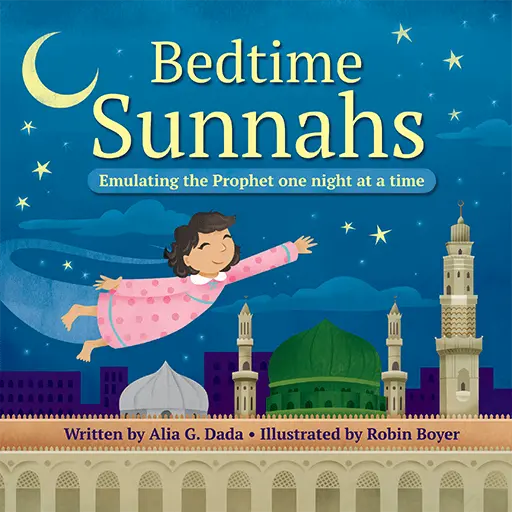
Bedtime Sunnahs, a two-minute rhyming picture book by Alia G. Dada for ages 4 to 9, walks a child through the whole routine: wudu, the adhkar, the three Quls, a dua, then Bismillah and the right side. It is a good first story for the first week of a new routine.
Which Islamic bedtime stories suit a four to six year old?
A child of four to six does best with one short story of two to five minutes, the same few stories many nights in a row, and a calm ending. These are all music-free, and none runs over five minutes:
| Story | Length | What it is about |
|---|---|---|
| A Bedtime Prayer for Peace | 2 min | Esa and his Mama pray for people in need and thank Allah before he sleeps |
| Alhamdulillah We Say | 2 min | A rhyme that thanks Allah for each season |
| A Little Girl's Prayers | 3 min | A girl talks to Allah from morning to bedtime |
| A Whale of a Wish | 4 min | The story of Prophet Yunus (peace be upon him), in rhyme, from the whale's side |
| A Cat and Mouse Pact | 5 min | A cat spares a mouse, and their promise becomes a friendship |
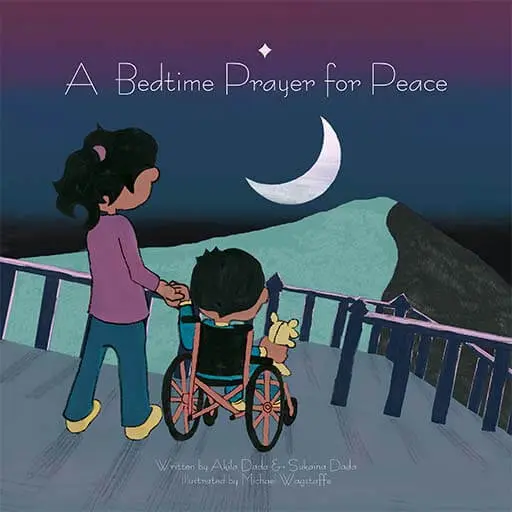
A Bedtime Prayer for Peace is the one to start with. It ends exactly where your child is: Mama tucks Esa in, turns off the light and prays for him. Afterwards, ask one of its questions in a whisper: "Who would you like to pray for tonight?"
For a child who wants "more", play one short book a night from a collection. My First Book About... Audio Collection has six short books about the Quran, Allah, the Prophet (peace be upon him), Ramadan, salah and Hajj (about 18 minutes in all). Allah Gave Me... Audio Collection has five rhyming books about the senses (about 15 minutes in all). Both are music-free.
Which longer stories suit a seven to nine year old?
A child of seven to nine can follow a longer story told over several nights, so choose one with short chapters and play one chapter at bedtime. Stopping at the end of a chapter also gives you an easy "that's all for tonight". The chapter length below is the total divided by the chapters, so some run longer.
| Story | Total | Chapters | About a chapter |
|---|---|---|---|
| A Gift of the Sands | 18 min | 4 | 4 to 5 min |
| Dawood and the Giant | 27 min | 6 | 4 to 5 min |
| Abdulqadir's Treasure | 36 min | 6 | 6 min |
| Sulayman and the Queen of Sheba | 38 min | 5 | 7 to 8 min |
| Adam & Hawwa | 26 min | 3 | 8 to 9 min |
- A Gift of the Sands: a proud pearl travels from the sea to the desert and learns contentment. Read by Sandy Walsh, and its page calls it "full of humour and adventure".
- Dawood and the Giant: Prophet Dawud (peace be upon him), a young shepherd, faces the giant Jalut. Its page says the giant is frightening at times, and that the shepherd boy, the sling and stone and the king's armour come from the Biblical telling, not from the Quran or hadith.
- Abdulqadir's Treasure: a boy's honesty changes a band of robbers. Its page says some scenes "with swords and daggers, are tense", so it suits an older child.
- Sulayman and the Queen of Sheba: a hoopoe brings news of a queen, and Prophet Sulaiman (peace be upon him) calls her to Allah. Its page says the story is in Surah An-Naml and the audiobook adds details of its own, such as the talking eagle.
- Adam & Hawwa: how Allah created Prophet Adam (peace be upon him) and Hawwa, and how He forgave them. For ages 7 to 9.
A Gift of the Sands, Dawood and the Giant and Abdulqadir's Treasure each have a music-free version. The pages for Sulayman and the Queen of Sheba and Adam & Hawwa say nothing about music, so for a music-free bedtime, choose one of the first three. For a child who is ready for one long story, The Bowing of the Stars tells the life of Prophet Yusuf (peace be upon him) in seven chapters, just under two and a half hours in all. Its page calls it "a long telling with grown-up moments" that "suits older children best", so listen to it yourself first.
Are there good Islamic audio stories beyond our library?
Yes. Once Upon A Crescent is an Islamic podcast for kids by Mrs. Hashimi, "a collection of Islamic stories for children" that she writes and produces, and she suggests it as a way "to settle into a bedtime routine" (Once Upon A Crescent, 2026). It is on Apple Podcasts and Spotify. Listen to an episode yourself first, for its length and whether it has music, and download it so the podcast app does not play the next one by itself.
The other option costs nothing and needs no device: your own voice. Reading a story aloud, or telling one you know, is still the best bedtime story there is. Audio is for the nights you are too tired, the nights a sibling needs you, or the child who asks for "the one with the whale" again.
Should bedtime stories be music-free?
That is a family's choice, and Muslim families and scholars take different views on music. Many Muslim families avoid music, or keep it to a minimum at home (music-free Islamic stories, 2026), while others are comfortable with some. For bedtime, music-free narration has a practical advantage too: a calm voice with no tune to sing along to.
Whichever you prefer, check before you press play. An audiobook page says so when a title has a music-free version, and the music-free page gathers the titles that do.
How do I choose a good Islamic audio story?
Choose a story with a real person's voice, a clear source for anything about the Prophets, a length that fits your child's age, and an ending that winds down rather than up. Four quick checks before a story joins the bedtime list:
- Who is reading? A human narrator, named on the page, reads with warmth and pauses. Listen to a sample first.
- Where does a Prophet story come from? A good one says it is adapted from the Quran, and says so when it adds details from later narrations.
- How long is it? Two to five minutes for four to six; one chapter of about four to nine minutes for seven to nine.
- How does it end? A chase or a battle at the end of a chapter is a daytime chapter.
The bedtime problem, a story without a screen, is one reason we made the Miraj audiobooks. Every one can be downloaded and played without an internet connection, and a no-music mode, set once by a parent, plays only the music-free versions. You can compare the Islamic apps for kids before you choose.
Frequently asked questions about Islamic bedtime stories
What should my child listen to before bed?
A short, calm Islamic story they already like: two to five minutes for a child of four to six, or one chapter of a longer story for seven to nine. Play it after the bedtime sunnahs, with the screen off and out of reach.
How long should a bedtime story be?
For a four to six year old, two to five minutes, so it ends before they lose the thread. For a seven to nine year old, one chapter of a longer story, and stop at the end of the chapter even if they ask for more.
How much do Islamic audiobooks for kids cost?
Podcasts such as Once Upon A Crescent are on Apple Podcasts and Spotify, and reading aloud costs nothing. A subscription app is the other route: in the UK, Miraj costs £69.99 a year or £6.99 a month, and the yearly plan starts with a 7-day free trial (pricing, checked 4 November 2026).
Which surahs are read before sleeping?
The Prophet (peace be upon him) recited Surat al-Ikhlas, al-Falaq and an-Nas into his cupped hands every night (Sahih al-Bukhari 5017), and confirmed that reciting Ayat al-Kursi at bedtime brings a guard from Allah through the night (Sahih al-Bukhari 5010).
Can my child fall asleep to an audio story?
Yes, if the device is out of reach and the sound stops by itself. On an iPhone, set the Clock timer to "Stop Playing" (Apple Support, 2026), and download the story first so nothing plays on after it.
Tonight, pick one short story, play it after the three Quls, and see how it goes. You can hear a sample of every title in our Islamic audiobooks for kids.
Explore the Miraj library
Explore the whole library
Read more from Miraj for Grown-ups
Ramadan Explained for Kids: What It Is and Why We Fast
How to explain Ramadan to your child, with words for each age, answers to the questions children ask, and ten facts for school.
How to Tell Your Child the Story of Prophet Nuh (and the Hard Parts)
The story of Prophet Nuh for a child of 4 to 7: a read-aloud in five short parts, the words for each age and honest answers to the hard questions.
What Age Should a Child Start Fasting? How to Start Small
A child does not have to fast until puberty. When to start practice fasts, the range of scholarly views and a gentle age-by-age plan.