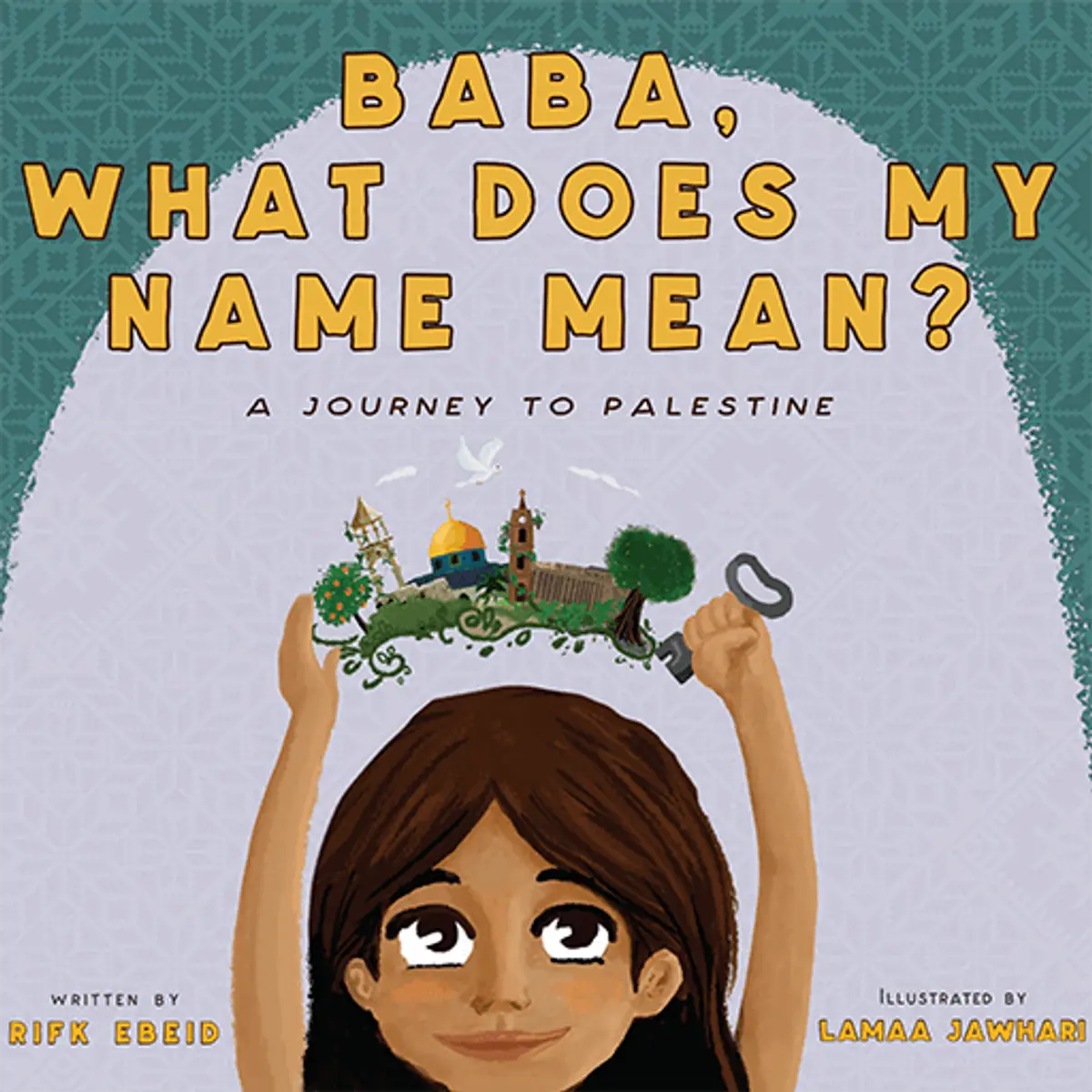
Baba, What Does My Name Mean?
A Palestinian girl asks what her name, Saamidah, means, and her baba takes her on a dream journey across Palestine. A picture book for ages 4 to 12.
Start with a 7-day free trial.
What is Baba, What Does My Name Mean? about?
Baba, What Does My Name Mean? is an Islamic picture book for children aged 4 to 12 about Saamidah, a young Palestinian refugee, who asks her father what her name means and is taken on a journey through her family's homeland.
When her friends at school ask about her name, Saamidah only knows that it is Arabic. That night, Baba tells her that it means someone who is patient and persistent, who perseveres and stands up for their rights without fear. He gives her the key from his necklace, the key to her ancestors' home, and in her dream she flies with Salam, a white dove of peace, across Palestine.
She rides a bicycle in Jericho, sees the golden Dome of the Rock at Al-Aqsa in Al-Quds, eats sesame bread in the old souk and knafeh in Nablus, and visits Yafa, the city her family comes from. She dances the dabke in Akka, weaves a carpet in Gaza, watches the Christmas parade in Bethlehem and meets a glassblower in Al-Khalil, near the Ibrahimi Mosque. At the end, Baba gives her a keffiyeh cape and a thobe from Yafa.
Written by Rifk Ebeid and illustrated by Lamaa Jawhari, the book celebrates Palestinian culture and the hope of return. It closes with Saamidah asking what made her a refugee, a question Baba saves for another night, which lets parents choose when and how to talk about it.
What your child will learn
- A name can carry a meaning and a story, and it is worth asking about.
- Patience and perseverance mean keeping going, even when things are hard.
- Palestine is home to Al-Aqsa in Al-Quds and the Ibrahimi Mosque in Al-Khalil.
- Knowing where our family comes from helps us understand who we are.
The story of Baba, What Does My Name Mean?
What does my name mean?
One day at school, Saamidah's friends asked her what her name meant. She told them proudly that it was an Arabic name, but then she did not know what else to say. That night, when Baba tucked her into bed, she asked him, "Baba, what does my name mean?"
What Baba said next swept her into a dream. Saamidah, he told her, is an Arabic word for someone who is patient and persistent, who perseveres, and who stands up for their rights without fear. "We named you this because you are Palestinian," he said. "Your name carries the weight of a nation loved by millions." Now, he said, was the perfect time to tell the story of the historic land of Palestine.
First he gave her a key from his necklace: the key to her ancestors' homes and a sign of her right to return. She must treat it like gold. Then he asked her to close her eyes and imagine. On a great olive tree sat a white dove called Salam, the dove of peace, and Saamidah would fly with her that night across the mountains, hills, deserts and plains of Palestine.
Jericho and Al-Quds
They began in Ariha, or Jericho, one of the oldest cities in the world and the lowest point on earth. The land there is flat, so they rode bicycles around the town in the bright sunshine, raced to the top of Tell al-Sultan, an ancient mound, and saw banana groves and palm trees as far as the eye could see.
Next came Al-Quds, Jerusalem, a holy city treasured by many faiths. The golden dome shining in the sun was the Dome of the Rock, Qubbat al-Sakhra, at Al-Aqsa, built with eight equal sides and decorated with marble and mosaics. Ancient stone walls protected the old city, and in the souk young men pushed carts piled with ka'ak, a sesame bread that tastes good on its own or stuffed with za'atar, eggs, falafel, tomatoes and pickles, with a cup of hot mint tea.
Nablus and Yafa
Then they headed north to Nablus for a slice of knafeh, a cheesy dessert made with shredded pastry and soaked in syrup. Afterwards Saamidah washed her sticky fingers with Nablus's famous olive oil soap, handmade from natural ingredients.
They flew along the Mediterranean coast to Yafa, which Palestinians call the Bride of the Sea. This was where Saamidah's family came from. Baba had often told her funny stories of his childhood there, from before the family was forced to leave, like the day he hid behind the clock tower in a game of hide-and-seek and a seagull pooped in his hair. He had told her that Yafa's oranges tasted like a dream, and that her grandfather's friend had published a newspaper there. Now she could see for herself that Yafa was a city bursting with culture.
Haifa, Akka and Gaza
Further north was Haifa, whose seaport and railway once made it a busy city full of different people, with Mount Carmel standing tall above the sea, full of caves, hills and trees. Then came Akka, with its old city, its ancient seaport and Khan al-Umdan, a shelter built for travelling caravans. There they took a boat out to sea and asked the captain to play Saamidah's favourite folk song, and she danced the dabke, stepping and stomping with joy for the homeland she longed for.
Because she was already good at the dabke, Baba said, she would learn something new in Gaza. At Hajj Mahmoud's carpet shop, she saw a wooden loom strung with hundreds of strands of yarn, and she learned to weave a carpet of her own, with the map of Palestine on it.
Bethlehem and Al-Khalil
Before sunset they hurried east to Bethlehem to watch its famous Christmas parade in Manger Square, beside the Church of the Nativity. The red, green, black and white colours of Palestine lit up the night, and young scouts played Arabic tunes on bagpipes.
To end the night, they went south to the historic city of Al-Khalil, or Hebron, and sat in one of the two minarets of the Ibrahimi Mosque, gazing at the moonlight. In the old souk, under beautiful arched roofs, Saamidah saw glass and ceramic souvenirs, and a man holding a long iron pipe with a flame at the end. He was a glassblower, using skills handed down to him. Al-Khalil is also famous for its pottery in a brilliant royal blue, and for its sheepskins and leather.
A superhero cape
As the journey came to an end, Baba gave her one last surprise: a cape made from a keffiyeh, a symbol of Palestine, to wear with pride like a superhero, and a hand-stitched Palestinian thobe in the style of Yafa, the hometown her family had lost.
Saamidah knew what her superpower would be. She would fly around the world and use her key to open people's minds, teaching everyone the truth about Palestine and its history. Through persistence and perseverance, she knew, one day they would be free.
Tomorrow's story
When she opened her eyes, she told Baba excitedly, "I love Palestine!"
"Yes, habibti, I know," he sighed.
"My homeland is so heavenly," she said. "Why must I long for it?"
"That is why we named you Saamidah, my love," said Baba, "because one day you will return to it."
"Insha'Allah, Baba, as soon as can be," she said. "But until then, can you tell me what made me a refugee?"
Baba took a deep breath and smiled softly. "Let's save that conversation for tomorrow's bedtime story."
Talk about it afterwards
- What does the name Saamidah mean?
- Which city in Palestine would you most like to visit, and why?
- Why did Baba give Saamidah the key from his necklace?
- Do you know what your own name means? Who could you ask?
Words to know
- Baba
- Dad, in Arabic.
- Al-Quds
- The Arabic name for Jerusalem.
- Dabke
- A Palestinian folk dance with steps and stomps, danced in a line.
- Keffiyeh
- A patterned scarf that is a symbol of Palestine.
- Habibti
- Arabic for "my darling", said to a girl.
- Insha'Allah
- If Allah wills.
Frequently asked questions
What age is Baba, What Does My Name Mean? suitable for?
Children aged 4 to 12. Younger children enjoy the dream journey and the food, and older children can talk about the history of Palestine and what it means to be a refugee.
How long is Baba, What Does My Name Mean?
About 11 minutes to read aloud.
Does Baba, What Does My Name Mean? explain why Saamidah is a refugee?
No. It ends with Saamidah asking what made her a refugee, and Baba saving that talk for another night, so parents can choose when to talk about it.
Who wrote Baba, What Does My Name Mean?
Rifk Ebeid wrote it, and Lamaa Jawhari illustrated it.