
Ramadan Explained for Kids: What It Is and Why We Fast
The words to use at four, six and eight, the questions children ask, ten facts for school and a section to share with the teacher.
12 min read Areeba Hasan
Summary
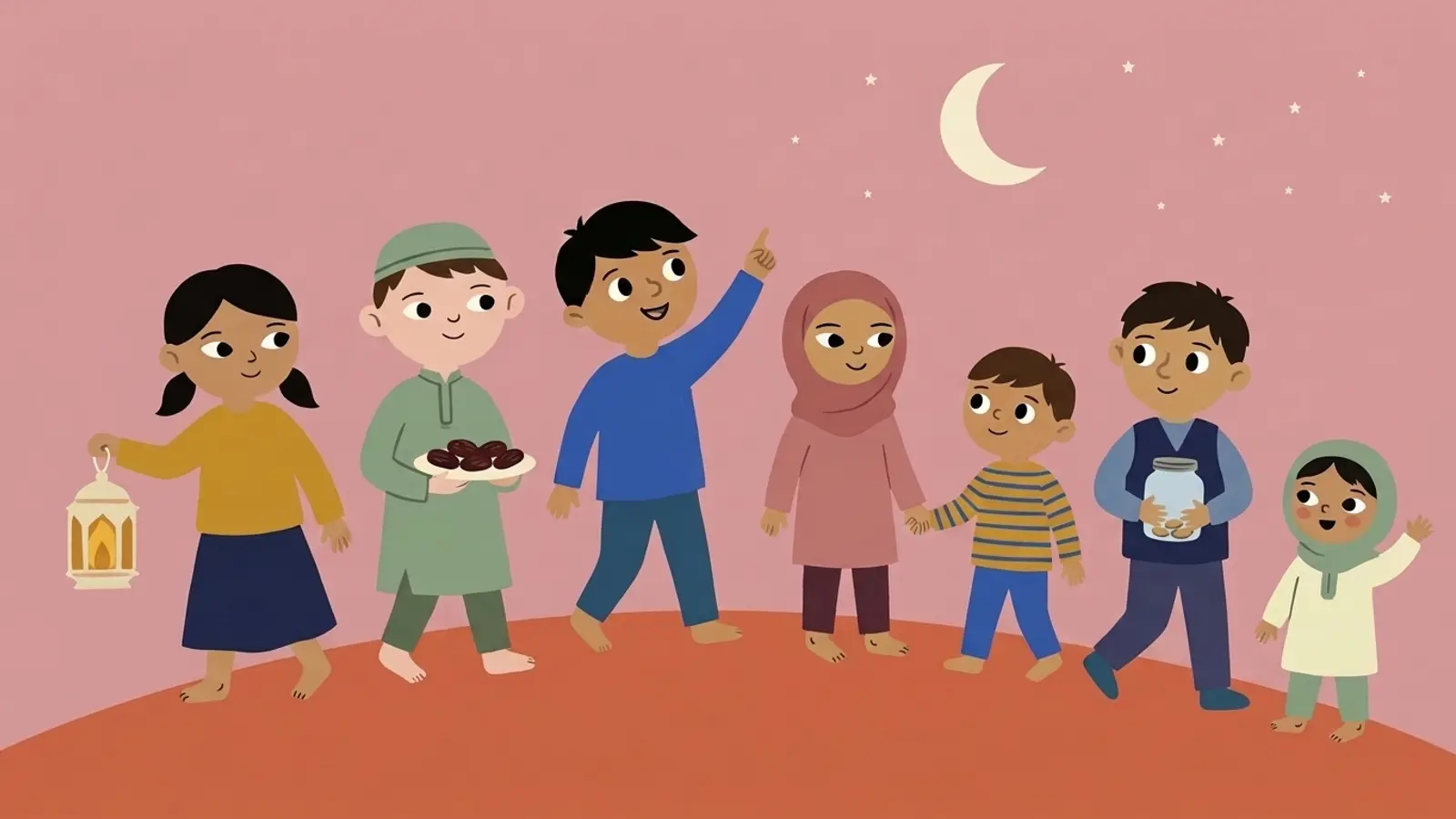
Ramadan is the ninth month of the Islamic year and the month the Quran was first revealed, when grown-up Muslims fast from dawn until sunset to grow closer to Allah, be thankful and remember people who have too little. Children do not have to fast until puberty: they join in by waking for suhoor, sharing iftar, giving and being extra kind, and the month ends with Eid al-Fitr.
It is the first iftar of the month. Your five-year-old looks up from a date and asks why Mama didn't eat any lunch, and why everyone was awake in the dark. You know the answer, but finding words a small child can hold is harder, and every answer brings another "but why?"
Here is the short version to say aloud: Ramadan is Allah's special month, when grown-up Muslims don't eat or drink from dawn until sunset, to feel close to Allah and to remember to be thankful. It is the month the Quran first came down, and at the end we celebrate Eid. Below are words for each age, short answers to the questions children ask, and a section to share with the teacher. For stories and activities through the month, see our Ramadan page for families.
What is Ramadan, in words a child can understand?
Ramadan is the month when Muslims fast, pray more and give more, and the month the Quran was first revealed. For a young child, two sentences are enough: "Ramadan is Allah's special month. Grown-ups fast from when it gets light until the sun goes down, and we all try to be extra kind and pray more."
For you, here is Ramadan in one minute:
- It is a month of the Islamic calendar. Britannica calls it "the ninth month of the Muslim calendar and the holy month of fasting in Islam" (Britannica).
- It is the month of the Quran. "The month of Ramadan [is that] in which was revealed the Quran, a guidance for the people" (Quran 2:185).
- It begins with the new moon and lasts 29 or 30 days. Prophet Muhammad (peace be upon him) said: "The month (can be) 29 nights (i.e. days), and do not fast till you see the moon" (Sahih al-Bukhari 1907).
- Each day starts with suhoor, a meal before dawn. The Prophet (peace be upon him) said: "Take Suhur as there is a blessing in it" (Sahih al-Bukhari 1923).
- Each fast ends at sunset with iftar, at Maghrib, often with a date.
- The nights have extra prayers, often prayed together in the mosque as taraweeh. The Prophet (peace be upon him) promised forgiveness to "Whoever prayed at night the whole month of Ramadan out of sincere Faith and hoping for a reward from Allah" (Sahih al-Bukhari 2009).
- It ends with Eid al-Fitr, and before the Eid prayer families pay zakat al-fitr.
Why do Muslims fast in Ramadan?
Muslims fast in Ramadan because Allah asked them to, so that they grow into better people. The Quran says: "O you who have believed, decreed upon you is fasting as it was decreed upon those before you that you may become righteous" (Quran 2:183). In a child's words: "Allah asked us to fast, like people long ago, to help us be good."
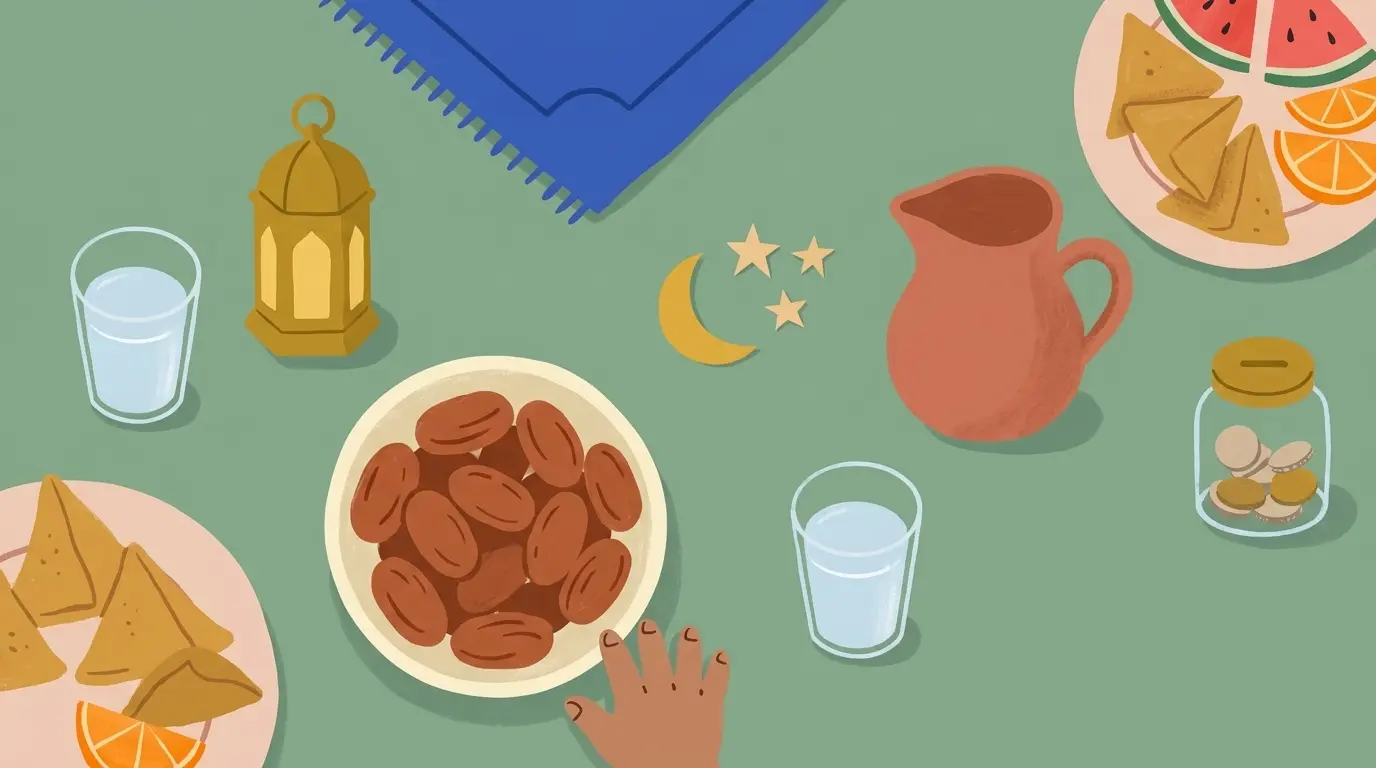
Beyond that first answer, four reasons are easy for a child to hold.
To feel close to Allah. Nobody else can see whether a fasting person has had a sip of water, but Allah sees. The Prophet (peace be upon him) said: "Whoever observes fasts during the month of Ramadan out of sincere faith, and hoping to attain Allah's rewards, then all his past sins will be forgiven" (Sahih al-Bukhari 38). For a child: "Allah sees our fast, and He loves to forgive."
To be thankful. The verse about the month of Ramadan ends with "and perhaps you will be grateful" (Quran 2:185). The first sip of water at iftar is the easiest way to show a child what thankful feels like.
To remember people who have too little, and to give. A day without food helps us understand hunger, and Ramadan is a month of giving. The Prophet (peace be upon him) "was the most generous of all the people, and he used to reach the peak in generosity in the month of Ramadan", when Jibril (peace be upon him) met him every night to teach him the Quran (Sahih al-Bukhari 6).
To be kind with our words too. Fasting is not only about food. The Prophet (peace be upon him) said: "Whoever does not give up forged speech and evil actions, Allah is not in need of his leaving his food and drink" (Sahih al-Bukhari 1903). He also said that "if somebody should fight or quarrel with him, he should say, 'I am fasting.'" (Sahih al-Bukhari 1904). It gives a child a calm thing to say instead of shouting back.
How do I explain Ramadan to a 4, 6 or 8 year old?
Start with what your child can see, add one reason, then add the bigger story as they grow.
| Age | What they can hold | Words to try |
|---|---|---|
| 3 to 4 | What they can see: the new moon, waking in the dark, dates at iftar, Eid at the end | "This is Ramadan, Allah's special month. Grown-ups don't eat in the day. We eat together when the sun goes down." |
| 5 to 6 | One simple reason, and a countdown to Eid | "We fast because Allah asked us to. It helps us say thank you for our food and remember people who don't have enough." |
| 7 to 8 | The bigger picture: the Quran came down in Ramadan, the moon calendar, Laylat al-Qadr, zakat al-fitr, kind words as part of the fast | "Ramadan is when the Quran first came down. Fasting isn't just no food, it's no unkind words too. If someone is rude, we can say 'I am fasting.'" |
Here is a short script to read aloud to a five-year-old on the first night:
Tonight we look for a tiny new moon, and when it comes, Ramadan begins. Ramadan is Allah's special month. Mama and Baba won't eat or drink from when it gets light until the sun goes down. Allah asked us to fast, and it helps us say thank you for our food. You don't have to fast yet, but you can help us lay the table for iftar. At the end of the month comes Eid, and we will celebrate together.
Change "Mama and Baba" to whoever fasts in your house. Read it again a few days later and let your child tell it back to you.
What questions do children ask about Ramadan?
Children ask "why?" again and again, and short, true answers work best. Each answer below has words for your child and the source for you.
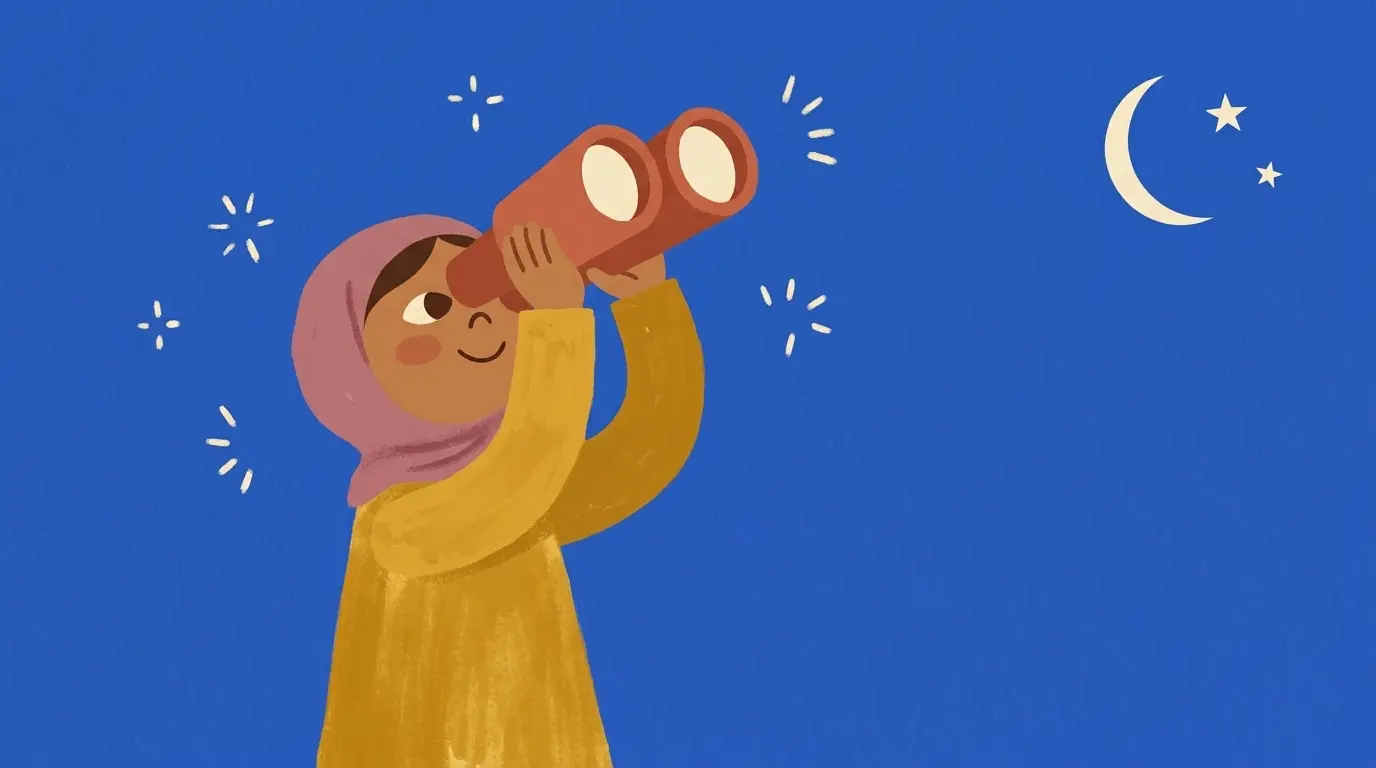
Why do we look for the moon?
Islamic months begin with the new moon, so the moon tells us when Ramadan starts and ends. Allah says of the crescent moons: "They are measurements of time for the people and for hajj [pilgrimage]" (Quran 2:189). If clouds hide it, the month before Ramadan is counted as 30 days (Sahih al-Bukhari 1907). For a child: "The moon is Allah's calendar in the sky."
Why does Ramadan come at a different time every year?
The Islamic year follows the moon, so it is shorter than the year on the kitchen calendar. "The Islamic calendar has 12 months with 29 or 30 days", and "An Islamic year consistently falls about 11 days short of the solar year" (timeanddate). So Ramadan comes about 11 days earlier each year.
Why don't I have to fast?
Because Allah does not ask children to fast. Fasting becomes a duty at puberty: the Prophet (peace be upon him) said there are "three (persons) whose actions are not recorded", and one of them is "a boy till he reaches puberty" (Sunan Abi Dawud 4403, graded Sahih by al-Albani). For a child: "You don't have to fast yet. When you're bigger, you can practise a little at a time." Scholars differ on when practice should begin; our guide to what age children should start fasting sets out the views and a gentle plan.
Isn't it unkind to make people hungry?
No. Fasting is meant to be within reach, and Allah says: "Allah intends for you ease and does not intend for you hardship" (Quran 2:185). People who are ill or travelling may miss days and make them up later (Quran 2:184). If a grown-up at home is eating, they may be unwell or travelling, and that is allowed too. Grown-ups eat at suhoor and iftar, and children don't have to fast at all. For a child: "It feels hard in the afternoon, but iftar feels wonderful."
What is Laylat al-Qadr?
It is the night the Quran was first sent down, in Ramadan. Allah says: "Indeed, We sent it [i.e., the Qur'an] down during the Night of Decree" (Quran 97:1), and "The Night of Decree is better than a thousand months" (Quran 97:3). The Prophet (peace be upon him) said: "Search for the Night of Qadr in the odd nights of the last ten days of Ramadan" (Sahih al-Bukhari 2017). For a child: "It is the most special night of the year. A good deed on that night is worth more than a thousand months."
Why does my friend eat lunch at school?
Not every family is Muslim, and Muslim children don't have to fast either. Both are fine. Teach kindness both ways: a friend who eats is doing nothing wrong, and a friend who fasts should never be teased for it. For a child: "Your friend can enjoy their lunch. And on a day you practise a fast, you can smile and say, 'I am fasting.'"
Why did my cousin's mosque start Ramadan on a different day?
Because mosques use different ways to decide when the month begins, and each follows the way it holds to be right. Britannica explains that the start "is made locally within different countries or even by different mosques". Some communities "base the beginning of Ramadan on astronomical calculations", while others wait for the crescent to be seen, "in which case cloud cover can create a delay" (Britannica). Some follow a sighting in their own area, others a sighting in another country. There is more than one view among scholars, so follow your local mosque. For a child: "Both mosques want to start on the right day. They just look in different ways."
What are the facts about Ramadan a child can use at school?
These ten facts are short enough for a KS1 or KS2 child to use in class. One is worth a word first: you will often read that Muslims fast "from sunrise to sunset", but the fast begins earlier, at dawn, the first light around Fajr. The Quran says to "eat and drink until the white thread of dawn becomes distinct to you from the black thread [of night]. Then complete the fast until the night" (Quran 2:187).
- Ramadan is the ninth month of the Islamic calendar.
- It lasts 29 or 30 days.
- It begins with the new crescent moon.
- It comes about 11 days earlier each year.
- Grown-up Muslims fast from dawn to sunset. Dawn comes before sunrise.
- The meal before dawn is called suhoor, and the meal at sunset is called iftar.
- The Quran was first revealed in Ramadan.
- Laylat al-Qadr, a night in Ramadan, is better than a thousand months.
- Before the Eid prayer, families give zakat al-fitr, a charity paid for every member of the family, children included (Sahih al-Bukhari 1503).
- Ramadan ends with a celebration called Eid al-Fitr.
How can teachers explain Ramadan in the classroom?
Teach Ramadan as a month of worship, plan around the expected dates, and treat a young pupil who fasts as practising. Ramadan 2027 is expected to begin on or around Monday 8 February 2027, with Eid al-Fitr on 9 or 10 March, subject to the moon (The National, updated 6 October 2026). Families will confirm with their mosque nearer the time.
In some areas, the February half-term falls in the second week of Ramadan. Luton's half-term is "Monday 15 February to Friday 19 February 2027" (Luton Borough Council). In Bristol, Term 3 runs to 12 February and Term 4 runs from 22 February to 25 March 2027 (Bristol City Council). So the first week and most of the month are school days. Dates vary by council and academy, so check your own.
Ramadan is a month of worship, and the celebration is Eid al-Fitr at the end. The greeting during the month is "Ramadan Mubarak" or "Ramadan Kareem", and at the end it is "Eid Mubarak".
Most primary pupils who fast are practising, since fasting is not a duty before puberty, so they may stop at any time. An older pupil who has reached puberty is fasting as a duty: talk to the family about PE and lunchtimes. For parents' notes, see our guide to children and fasting. If your class uses tablets, Miraj Stories for schools puts the whole library, Ramadan stories included, on every device.
How can my child join in at home?
Children can take part long before they fast every day, by waking for suhoor, breaking the fast at iftar and reading the Quran with their family, as our Ramadan page puts it. Try two or three of these:
- Wake for suhoor at a weekend and eat with the family.
- Hand out the dates at iftar, the way the Prophet (peace be upon him) broke his fast.
- A sadaqah jar for coins, given away before Eid.
- A kind-deeds chart with a star for each kind word or helping hand.
- A story at bedtime. The My First Book About collection in the Miraj Stories app is a gentle listen for the end of a long day.
Frequently asked questions about Ramadan for kids
What does Ramadan mean for children?
For a child, Ramadan is a month of joining in rather than fasting: waking for suhoor, sharing iftar, giving and being extra kind. Children don't have to fast until puberty.
What is Ramadan in simple words?
Ramadan is the ninth month of the Islamic year, when grown-up Muslims fast from dawn to sunset, pray more and give more. It is the month the Quran was first revealed, and it ends with Eid al-Fitr.
When is Ramadan 2027?
It is expected to begin on or around Monday 8 February 2027, with Eid al-Fitr on 9 or 10 March 2027, depending on the moon (The National). Ask your local mosque nearer the time.
Do children fast in Ramadan?
Children don't have to fast until puberty, though they can practise with a few hours or a half day as they grow. Scholars differ on when to start practising, so follow your local mosque.
What is Eid al-Fitr?
Eid al-Fitr is the celebration at the end of Ramadan, beginning with the Eid prayer, before which families pay zakat al-fitr for everyone in the household. For the day itself, see our Eid al-Fitr page.
Why do Muslims eat dates to break the fast?
Because the Prophet (peace be upon him) did. He "used to break his fast before praying with some fresh dates; but if there were no fresh dates, he had a few dry dates, and if there were no dry dates, he took some mouthfuls of water" (Sunan Abi Dawud 2356, graded Hasan Sahih by al-Albani).
Where to go next
Before the month begins, sit with your child and look through our Ramadan stories and activities together. Choose one thing they will do each day, and read the script above on the night you look for the moon.
Explore the Miraj library
Explore the whole library

Read more from Miraj for Grown-ups
How to Tell Your Child the Story of Prophet Nuh (and the Hard Parts)
The story of Prophet Nuh for a child of 4 to 7: a read-aloud in five short parts, the words for each age and honest answers to the hard questions.
What Age Should a Child Start Fasting? How to Start Small
A child does not have to fast until puberty. When to start practice fasts, the range of scholarly views and a gentle age-by-age plan.
How to Explain Isra and Mi'raj to Children
How to explain Isra and Mi'raj to a child of 4 to 9, with the words to use at each age and honest answers to the questions they ask.