
How to Tell Your Child the Story of Prophet Nuh (and the Hard Parts)
A read-aloud in five short parts, what to tell at four, five, six and seven, and honest answers about the flood, the people who drowned and the son who would not board the ark.
14 min read Areeba Hasan
Summary
Tell the story of Prophet Nuh (peace be upon him) as the story of a patient Prophet whom Allah kept safe: he stayed among his people for 950 years, calling them to Allah night and day, built the ark, and Allah saved him, the believers and the animals on the ark from the flood. Keep the first telling short, over several nights, and name the flood plainly and gently. Answer the hard questions, such as the people who drowned and his son, honestly, including where scholars differ and where the Quran is silent.
When your child hears about the ark and asks "Did everyone drown?", tell them the truth gently: the people who would not listen drowned in the flood, and Allah kept Prophet Nuh (peace be upon him), the believers and the animals on the ark safe. Tell it as the story of a patient Prophet whom Allah protected, in short sittings, and keep the hardest parts for when your child asks.
This guide gives you the story in five short parts to read aloud, each with its verse, the words to use at four, at five and six, and at seven, and honest answers to the questions children ask, including where scholars differ. If you want the story on its own first, our page of Prophet Nuh stories for kids has it in a few lines.
What is the story of Prophet Nuh, in words a child understands?
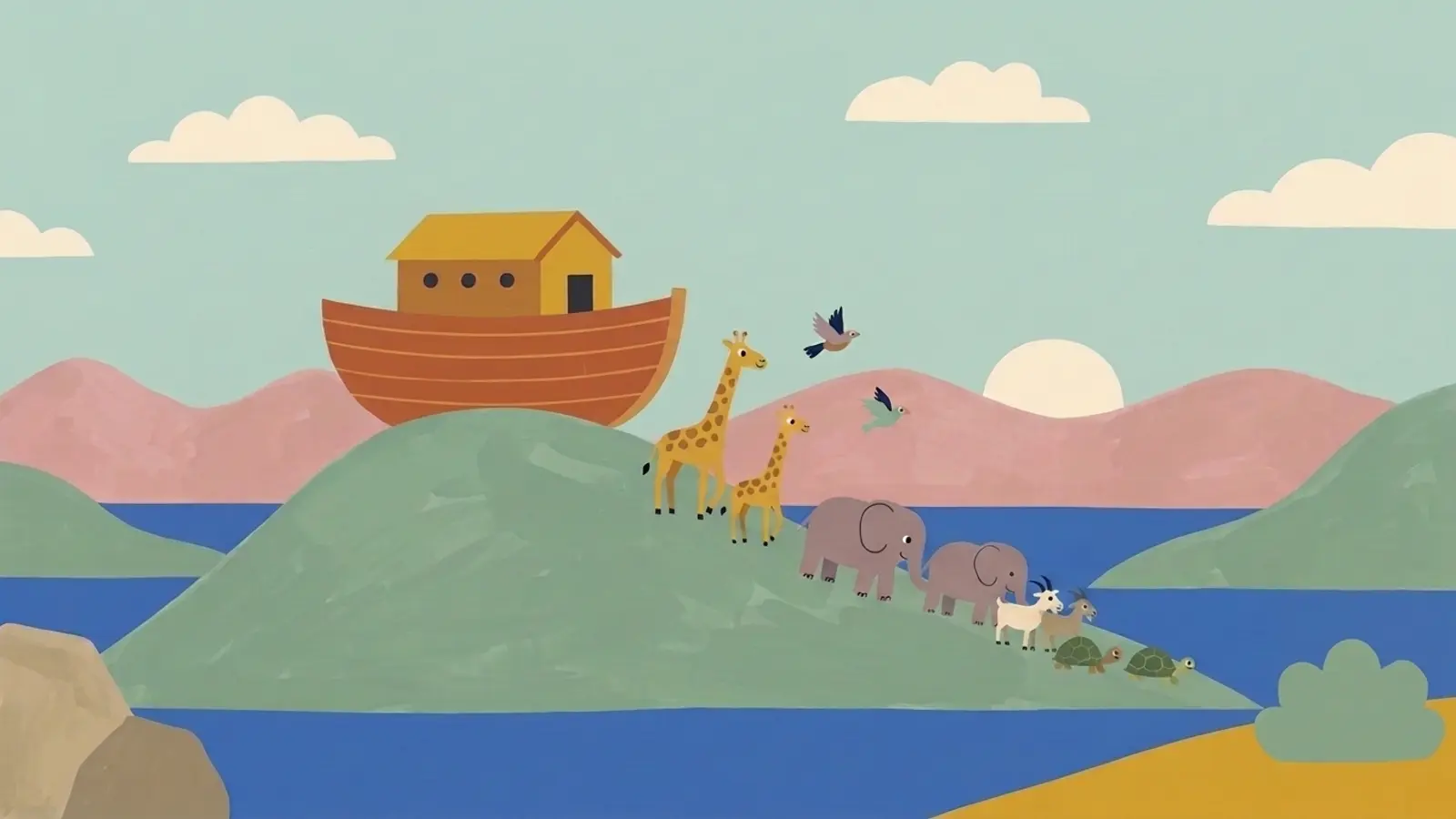
For a child, the story is this: Nuh called his people to worship Allah alone for a very long time, most of them laughed at him, Allah told him to build an ark, and Allah saved Nuh, the believers and the animals on the ark from a great flood. Every part is in the Quran; the verses below are in the Sahih International translation.
Do not tell it all at once. As one guide for parents puts it, "keep it short. You can always split the story over several days," with a quick recap of the last part before the next (Teach Me Islam). Five parts make five short bedtimes, or two or three longer ones. For a four-year-old, use the shorter telling under "What should I tell a four-year-old?"; the five parts suit five to seven.
1. The call. A long, long time ago, Allah sent Prophet Nuh to his people. Nuh told them: "Worship only Allah." He told them in the day, and he told them in the night. But most of the people did not want to listen. Some of them even put their fingers in their ears! Nuh did not give up. He stayed with his people for 950 years.
Nuh tells Allah, "I invited my people [to truth] night and day" (Quran 71:5), and that "they put their fingers in their ears" (Quran 71:7). He "remained among them a thousand years minus fifty years" (Quran 29:14).
2. The ark, and the laughing. Then Allah told Nuh to build a big boat, an ark. Allah was watching over him the whole time, plank by plank and nail by nail. There was no flood yet. So every time the important people walked past, they laughed at him. Nuh kept building.
Allah said, "construct the ship under Our observation" (Quran 11:37); as the chiefs passed, "they ridiculed him" (Quran 11:38). It was made of "planks and nails" (Quran 54:13).
3. The animals in pairs. When the time came, Allah told Nuh to bring two of every kind of animal onto the ark, and his family, and everyone who believed. Only a few people believed. Nuh said, "In the name of Allah," and they went aboard.
Allah said to load "of each [creature] two mates and your family, except those about whom the word [i.e., decree] has preceded, and [include] whoever has believed." "But none had believed with him, except a few" (Quran 11:40). Nuh said, "Embark therein; in the name of Allāh [are] its course and its anchorage" (Quran 11:41).
4. The waves like mountains. Then rain poured down from the sky, and water burst up out of the ground. The ark sailed on waves as big as mountains. Nuh called to his son, who was away from the others: "My son, come aboard with us!" But his son said, "I will climb a mountain. It will keep me safe." The waves came between them, and the son drowned.
Allah "opened the gates of the heaven with rain pouring down" and "caused the earth to burst with springs" (Quran 54:11-12). The ark "sailed with them through waves like mountains" (Quran 11:42), and the son "was among the drowned" (Quran 11:43).

5. The water goes down. Then Allah said: "Earth, swallow your water. Sky, hold back your rain." The water went down, and the ark came to rest on a mountain called al-Judi. Allah told Nuh to step off the ark, safe and with blessings. Nuh, the believers and the animals were safe.
"O earth, swallow your water, and O sky, withhold [your rain]." And the ark "came to rest on the [mountain of] Jūdiyy" (Quran 11:44). Then: "O Noah, disembark in security from Us and blessings upon you" (Quran 11:48).
What should I tell a four-year-old?
Tell a four-year-old about the ark, the animals two by two and how Allah kept everyone on the ark safe, and leave out Nuh's son unless they ask. At this age a child holds on to a picture and a feeling. You can use these words, or your own:
A long time ago, Prophet Nuh asked his people to worship Allah. Most of them would not listen, and some of them laughed. Allah told Nuh to build a big, big boat. Nuh built it, and the animals came, two by two: two elephants, two lions, two little birds. Nuh and the people who believed went inside. Then the rain came, and the water rose and rose. The people who would not listen were not on the ark, and they drowned. But Allah kept everyone on the ark safe, until the water went down and the boat stopped on a mountain.
Name the flood plainly and gently, once, and move on to the safe ending. If your child asks about the people in the water, the answers below give you a line to say.
What can I add at five and six?
At five and six, add the part about patience: Nuh stayed with his people for 950 years and kept calling them, even when they laughed at him and would not listen. Children of this age know what it feels like to be laughed at.
Try the fingers in the ears together. Ask your child to put their fingers in their ears, then say something kind to them, quietly. Can they hear you? Then swap. Explain that this is what Nuh's people did when he called them (Quran 71:7), and that he still did not stop. Ask: "What would you do if your friends laughed when you did something good?"
Tell it over two or three nights, starting each with a recap: "Do you remember what Nuh was building?" Our stories about patience carry the same lesson into other stories.
How do I tell a seven-year-old about Nuh's son?
Tell it as a choice the son made: his father called him to the ark, he trusted a mountain instead, and the mountain could not save him. Nuh's answer to his son is the heart of it: "There is no protector today from the decree of Allāh, except for whom He gives mercy" (Quran 11:43).
A seven-year-old can also hear what Nuh did next. He asked Allah: "My Lord, indeed my son is of my family; and indeed, Your promise is true" (Quran 11:45). Allah answered, "indeed he is not of your family; indeed, he is [one whose] work was other than righteous" (Quran 11:46). Ibn Kathir explains it as Allah saying: "I only promised you that I would save those of your family who believe" (Tafsir Ibn Kathir on 11:46). Nuh accepted it and asked Allah for forgiveness (Quran 11:47).
You can put it this way: "Nuh loved his son very much. But being safe was not about whose son you were. It was about believing in Allah."
Some children take this part better from someone else first. In the Miraj Stories library, Juz by Juz: Nuh and His Sons is a 17-minute video for ages 4 to 9, with a music-free version, in which Sheikh Azhari and his children tell the story, including the son, whom the Sheikh calls Yam. The Sheikh also says the ark had three levels; the video's page notes that this comes from later narrations.
How do I answer my child's hard questions?
Answer briefly and honestly, and say "scholars have different views" when they do. It is better to say "the Quran doesn't tell us" than to fill the gap.
"Did the children drown?"
Scholars give two answers. One is a report that no young child died. On Quran 11:44, al-Qurtubi records, as something "it is said", that Allah made the people's women unable to have children for forty years before the flood, "so there was no young child among those who perished" (Tafsir al-Qurtubi on 11:44, our translation from the Arabic). On Quran 71:11 he records a similar report from Muqatil: after the people had long denied Nuh, Allah held back the rain and their women had no children for forty years (Tafsir al-Qurtubi on 71:11).
Al-Qurtubi's own view, which he calls the correct one, is that children did die in the flood, as the birds and the animals did, but "the drowning was not a punishment for the children, the animals and the birds; rather they died at their appointed times" (the same page, our translation).
Either way, the answer for a family is the same: the flood was not a punishment for the children. The Quran says, "Indeed, Allāh does not do injustice, [even] as much as an atom's weight" (Quran 4:40), and "no bearer of burdens will bear the burden of another" (Quran 17:15). With a four-year-old, do not raise this unless they ask.
Say: "Some scholars say there were no little children then. Others say there were. But the flood was not a punishment for any child, because Allah is never unfair, not even a tiny bit." If your child asks where the children are now, you can say: "Allah knows, and Allah is the Most Merciful."
"Why didn't Allah save his son?"
Because Allah's promise was to save the people of Nuh's family who believed, and the son did not believe. Nuh called him to the ark, and he chose the mountain (Quran 11:42-43). Allah had told Nuh this when He first gave the order to load the ark: "your family, except those about whom the word [i.e., decree] has preceded" (Quran 11:40). Ibn Kathir reports that Ibn 'Abbas (may Allah be pleased with him) said, "He was the son of Nuh, but he opposed him in deeds and intention" (Tafsir Ibn Kathir on 11:46).
Say: "Allah promised to save the people who believed. Nuh's son didn't believe, and he chose the mountain instead of the ark."
"Did the water cover the whole world?"
The Quran does not say, and scholars differ. A fatwa answer on Askimam sums it up: "The Quran has not specified the exact location or magnitude of the flood." It explains that Ibn Kathir and al-Baghawi held that the flood was global, while Ibn 'Atiyyah held that it was regional. It adds: "Focusing on the geographical aspect of the event is not the purpose of it being mentioned in the Quran" (Askimam on IslamQA.org).
Say: "The Quran doesn't tell us how far the water went. It tells us that Allah saved the people who listened."
"How many sons did Nuh have?"
The Quran names none of Nuh's children. It tells of one son who drowned (Quran 11:42-43) and says, "We made his descendants those remaining [on the earth]" (Quran 37:77). A hadith says this verse means three sons, Ham, Sam and Yafith (Jami' at-Tirmidhi 3230). At-Tirmidhi called it hasan gharib; Darussalam grades it Da'if (weak).
Ibn Kathir names the son who drowned Yam (on 11:40-43). Al-Baghawi names him Kan'an (on 11:40), and al-Qurtubi gives both names (on 11:42).
Say: "The Quran doesn't tell us their names. Some old reports call three of his sons Ham, Sam and Yafith, and the son who drowned Yam or Kan'an."
"Did it rain for forty days? Was there a rainbow?"
The Quran gives no number of days and no rainbow. It says the gates of the sky opened and the earth burst with springs (Quran 54:11-12). The forty days and nights of rain are in the Bible's account of Noah (Genesis 7:12), and so is the rainbow (Genesis 9:13).
Some children's retellings online add the forty days. One retelling for Muslim children online says "Rain poured for 40 days" (islam4kids).
Say: "That part is in the Bible's story of Noah. The Quran tells us the sky opened and water came up from the ground, but it doesn't say how many days."
What is the one lesson to draw out at each age?
Pick one lesson for your child's age and say it out loud. Children forget the details and keep the lesson.
| Age | The lesson | Words to use |
|---|---|---|
| 4 | Allah keeps us safe | "Allah kept Nuh and everyone on the ark safe. Allah looks after us too." |
| 5 to 6 | Keep doing what is right, even when people laugh | "Nuh stayed with his people for 950 years and kept going, even when they laughed at him. We can be patient too." |
| 7 | Only Allah can protect us, so we choose to listen | "The mountain could not save Nuh's son. Only Allah can protect us." |
The Quran itself asks the question the story leaves behind: "And We left it as a sign, so is there any who will remember?" (Quran 54:15).
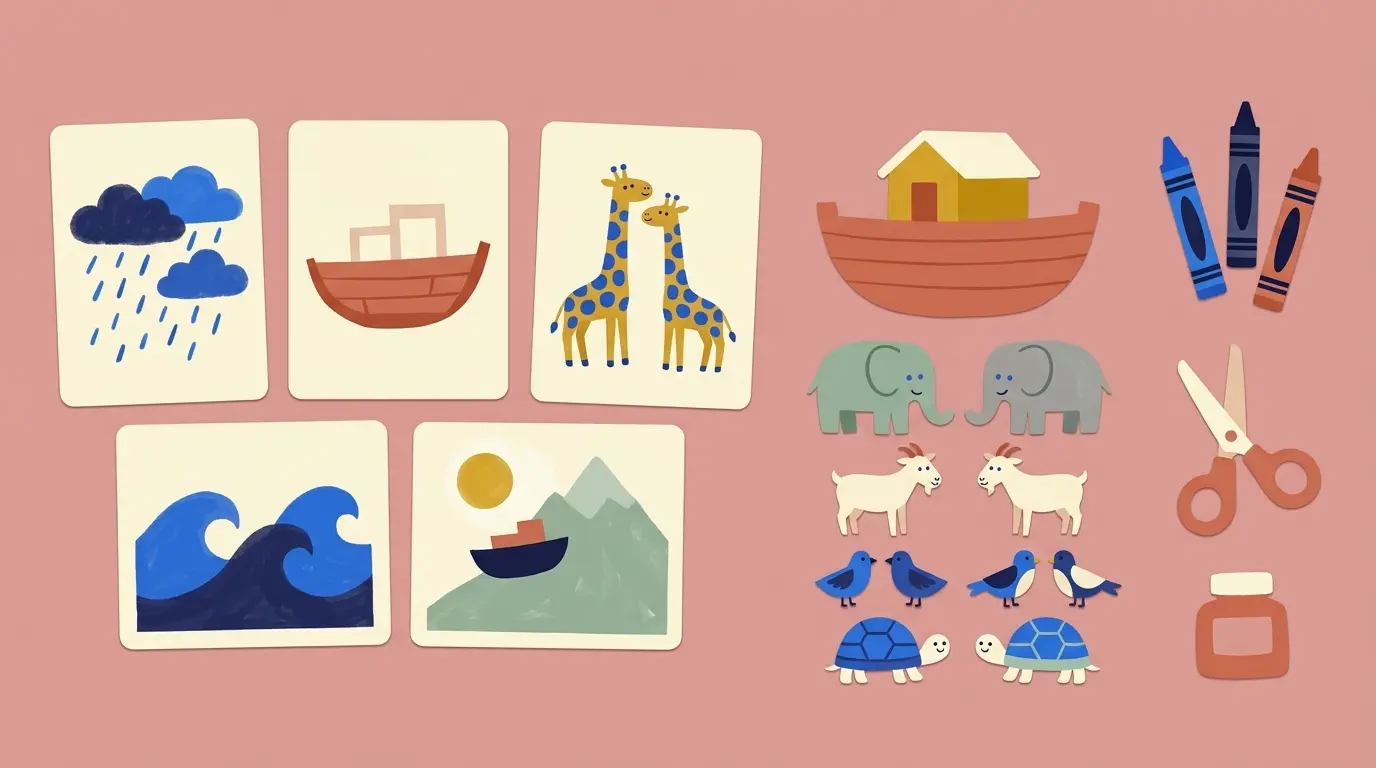
A simple activity at the table helps the story stay:
- Order the story cards. Draw five cards: a half-built boat, two animals of one kind, rain clouds, big waves, and a boat on a green mountain. Shuffle them and ask your child to put them in order and tell you the story. Keep Nuh himself off the cards: the boat, the animals and the water tell it.
- Pair the animals. Cut out paper animals, two of each, mix them up and let your child find the pairs.
- Make a paper ark. Fold or cut a simple boat, and glue the pairs inside it.
How can teachers tell the story of Nuh in the classroom?
In Reception and KS1, tell the story of Nuh in short parts over several sessions, with a quick recap at the start of each. The story cards make a sequencing task: pupils put the pictures in order, then retell the story to a partner.
Older pupils in RE can compare the Quran's account with the Bible's account of Noah. The forty days of rain and the rainbow are a clear place to start, since they appear in Genesis and not in the Quran.
If your school or madrasah uses tablets, the Miraj Stories for schools page explains how the stories sit beside your lessons.
Frequently asked questions about telling the story of Nuh
How old was Prophet Nuh?
The Quran says Nuh remained among his people "a thousand years minus fifty years", 950 years (Quran 29:14). It does not give his full age.
Which prophet built the ark in Islam?
Prophet Nuh (peace be upon him), known as Noah in English, built the ark. Allah told him to "construct the ship under Our observation and Our inspiration" (Quran 11:37).
How many children did Prophet Nuh have?
The Quran does not say. It mentions one son who drowned (Quran 11:42-43) and says his descendants remained (Quran 37:77); a hadith names three sons, Ham, Sam and Yafith (Jami' at-Tirmidhi 3230; at-Tirmidhi called it hasan gharib, and Darussalam grades it weak).
Where did the ark land?
The ark came to rest on al-Judi (Quran 11:44). Ibn Kathir reports Mujahid's words: "Judi is a mountain in Al-Jazirah (Northwest Mesopotamia)" (Tafsir Ibn Kathir on 11:44).
Where is the story of Nuh in the Quran?
The fullest telling of the ark and the flood is in Surah Hud (11:25-49), and Surah Nuh (71) is named after him. The story is also told in, among other places, Surah al-A'raf (7:59-64), Surah Yunus (10:71-73), Surah al-Mu'minun (23:23-30), Surah ash-Shu'ara (26:105-122), Surah al-'Ankabut (29:14-15), Surah as-Saffat (37:75-82) and Surah al-Qamar (54:9-15).
What lesson should children take from the story of Nuh?
Be patient and keep doing what is right, even when people laugh, and trust that only Allah can protect us. The Quran calls the story "a sign" for us to remember (Quran 54:15).
Where to go next
Watch Juz by Juz: Nuh and His Sons with your child this week, then ask them which part they would draw first. Our page of Prophet Nuh stories for kids has the story in a few lines. For the next story, our guide on how to explain Isra and Mi'raj to children works the same way: the story first, then the questions.
Explore the Miraj library
Explore the whole library
Read more from Miraj for Grown-ups

What Age Should a Child Start Fasting? How to Start Small
A child does not have to fast until puberty. When to start practice fasts, the range of scholarly views and a gentle age-by-age plan.
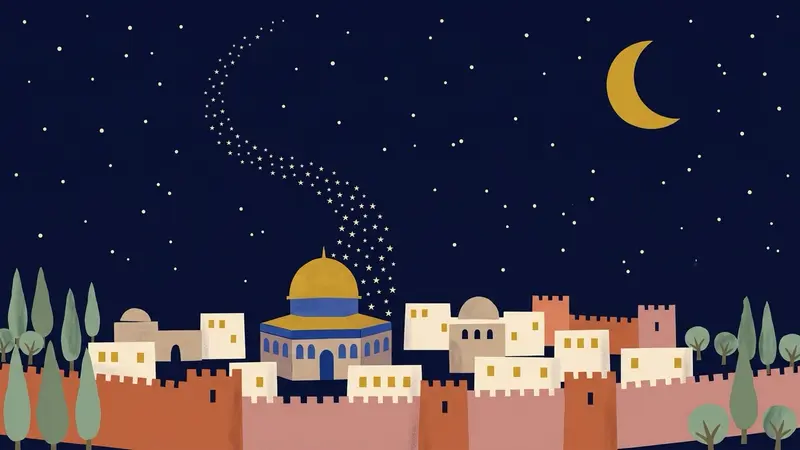
How to Explain Isra and Mi'raj to Children
How to explain Isra and Mi'raj to a child of 4 to 9, with the words to use at each age and honest answers to the questions they ask.
Best Islamic Apps for Kids (2026), by Age and Need
The best Islamic apps for kids in 2026, sorted by age and by what you want them for, with prices, ads and music checked on the day.