
How to Explain Isra and Mi'raj to Children
What to say at four and five, what to add from six, and honest answers to the questions children ask about the Night Journey.
10 min read Areeba Hasan
Summary
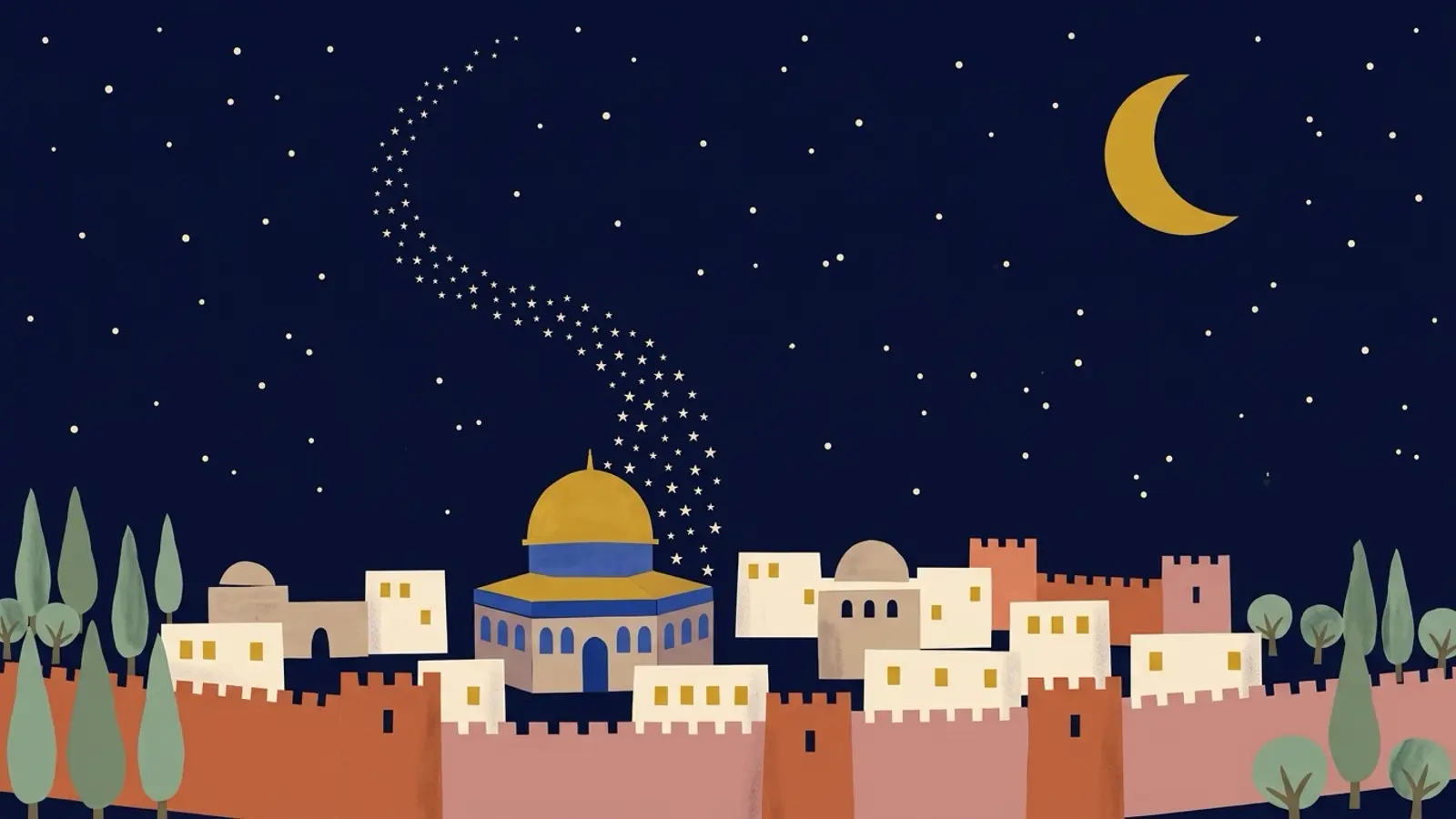
Isra and Mi'raj is the night Allah took the Prophet Muhammad (peace be upon him) from Makkah to Jerusalem and then up through the heavens, where the five daily prayers were given. Tell a four or five year old a short story that ends with a gift, salah. From six, add Jerusalem on a map, the meeting with Prophet Musa (peace be upon him) and honest answers to their questions, then watch or read the story together.
"Did he really fly?" Sooner or later, a child who hears about the Night Journey asks it, often at bedtime and often when you are not sure of the answer yourself. The short answer: in one night, Allah took the Prophet Muhammad (peace be upon him) from Makkah to Jerusalem and then up through the heavens, and he came back with the five daily prayers. For a young child, that is the whole story: a journey in one night that ends with a gift.
This guide is for the parent who wants to tell it well. It gives you the words to use with a four or five year old, what to add for a child of six to nine, short and honest answers to the questions children ask, and simple ways to mark the night at home. If you only want the story itself, our Isra and Mi'raj page for kids has it in a few lines, with the story to watch or read together.
What is the Night Journey, in words a child understands?
Isra and Mi'raj (also written Isra and Miraj, Isra Miraj, Lailat al-Mi'raj, or Shab-e-Miraj in Urdu) is one night in two parts. The Isra is the Night Journey from the Sacred Mosque in Makkah to the Farthest Mosque, al-Aqsa, in Jerusalem. The Mi'raj is the ascent, the climb from Jerusalem up through the heavens.
The Isra is in the Quran. Surah al-Isra begins: "Glory be to the One Who took His servant ˹Muḥammad˺ by night from the Sacred Mosque to the Farthest Mosque whose surroundings We have blessed, so that We may show him some of Our signs" (Quran 17:1, The Clear Quran). Surah an-Najm tells of the Lote Tree at the farthest boundary, and says: "He certainly saw some of his Lord's greatest signs" (Quran 53:18, The Clear Quran). The details, such as the prophets he met and the prayers, come from the hadith.
The facts a child can hold on to:
- It happened in one night.
- Part one, the Isra: from Makkah to Jerusalem.
- Part two, the Mi'raj: from Jerusalem up through the heavens.
- He rode al-Buraq, a white animal sent for the journey.
- He came back with a gift for every Muslim: the five daily prayers.
- Many Muslims remember it on 27 Rajab, the seventh month of the Islamic year.
If your child asks why the word sounds familiar, Mi'raj is also the word in our own name, Miraj Stories.
What should I tell a four or five year old?
Tell a four or five year old a short story with a beginning, a ride, a meeting and a gift. At this age, children remember a picture and a feeling, not a list of places. You can use these words, or your own:
One night, a long time ago, Allah sent the angel Jibril to the Prophet Muhammad in Makkah. Jibril brought a white animal called al-Buraq, and it carried the Prophet very fast, all the way to a big mosque in Jerusalem. Then Allah took the Prophet up, up, up through the heavens, higher than anyone had ever been. There, Allah gave him a present for all of us: the prayer. That is why we pray. Every time we pray, we remember that night.
That is enough. Let your child ask what they want to ask, and answer only that. Leave the longer parts of the hadith, such as the opening of the chest and the details of what was seen in each heaven, for when they are older.
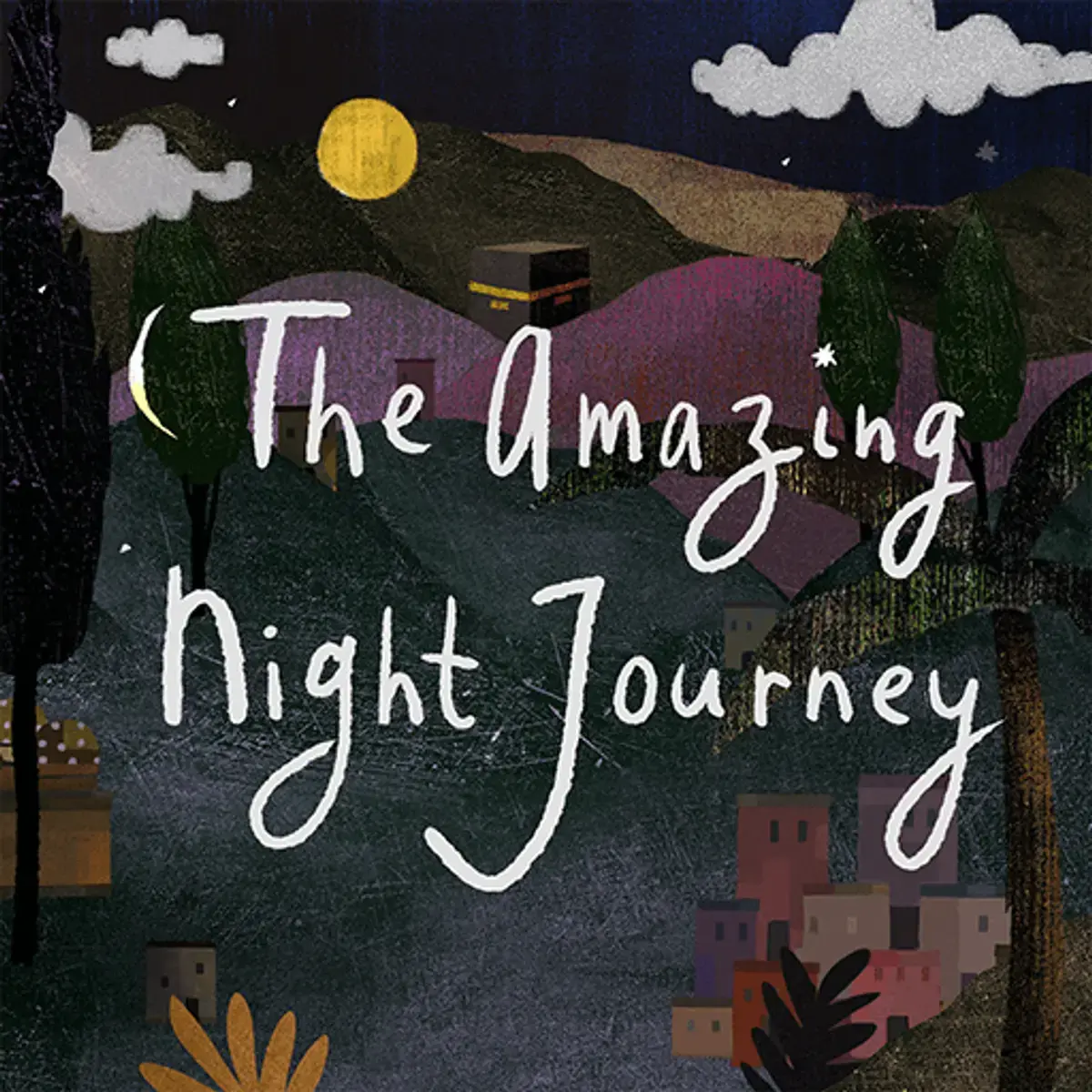
For a first telling, it helps to see it. The Amazing Night Journey tells the night in about five minutes, for ages 4 to 9, with night skies, the Kaaba and Masjid al-Aqsa. Its page also has questions to talk about afterwards. Like all our stories of the Prophets, The Amazing Night Journey is reviewed by Islamic scholars and based on the Quran and authentic hadith.
What can I add for a child of six to nine?
From about six, a child can follow the journey on a map and wants to know why things happened. Add three things.
Where it happened. Open a map and find Makkah, then Jerusalem. In the hadith narrated by Anas (may Allah be pleased with him), the Prophet (peace be upon him) rode al-Buraq to Jerusalem, tied it up and prayed in the mosque (Sahih Muslim 162a). In another narration he says of the earlier prophets: "When the time of prayer came I led them" (Sahih Muslim 172). Many children like knowing that the prophets they know, Ibrahim, Musa and Isa (peace be upon them), all prayed together.
Why there are five prayers. In the hadith narrated by Abu Dharr (may Allah be pleased with him), fifty prayers a day were first made obligatory. On the way down, Prophet Musa (peace be upon him) sent him back to ask for fewer, again and again, until Allah said: "These are five prayers and they are all (equal to) fifty (in reward) for My Word does not change" (Sahih al-Bukhari 349). Many six year olds find this part fair and a little funny: five to do, fifty in reward.
What came before. The journey is often told as coming after a very hard time. In the Year of Sorrow, the Prophet (peace be upon him) lost his wife Khadijah (may Allah be pleased with her) and his uncle Abu Talib, and the people of Ta'if turned him away (The Sealed Nectar). Seerah scholars differ on the exact year (AboutIslam), and nothing in the authentic hadith ties the night to Rajab or any other month (IslamQA 60288). For a child, the point is simple: after sadness, Allah gave comfort.
How do I answer my child's hard questions?
Answer briefly and honestly, and say "scholars have different views" when they do. A child trusts a parent who says "we do not know exactly" more than one who makes something up.
"Did he really fly?"
Say: "It was a miracle, something only Allah can do." In his commentary on Quran 17:1, Ibn Kathir writes that the Prophet "was taken on the Night Journey with body and soul; he was awake, not asleep" (Tafsir Ibn Kathir), and this is the view of most scholars (IslamQA 84314). Ibn Abbas (may Allah be pleased with him) said the sights were "actual sights, (not dreams)" (Sahih al-Bukhari 3888). Some, especially among the Sufis, understand it as a journey of the spirit.
"What was al-Buraq?"
The Prophet (peace be upon him) described "a white animal which was smaller than a mule and bigger than a donkey" (Sahih al-Bukhari 3887). That is all we are told of its shape, so there is no need to draw it. Let your child picture it in their own head.
"Did he see Allah?"
This one the Companions themselves discussed. Aishah (may Allah be pleased with her) held that he did not (Sahih al-Bukhari 4855). Asked by Abu Dharr, the Prophet (peace be upon him) said: "(He is) Light; how could I see Him?" (Sahih Muslim 178a). Ibn Abbas is reported to have said he saw Allah "with his heart" (Sahih Muslim 176a). For a child: "The Quran says he saw some of Allah's greatest signs. Scholars have talked about the rest for a very long time."
"Why do we pray five times, not fifty?"
Because Allah made it easy for us and kept the reward of fifty. Show them the five on a clock: Fajr, Dhuhr, Asr, Maghrib and Isha. Our stories about salah carry on from there.
"Can I go there?"
Yes, one day, if Allah wills. Both places are real and still stand today: al-Aqsa in Jerusalem, and the Sacred Mosque around the Kaaba in Makkah, where the journey began. Find pictures of them together and put them side by side.
What is the one lesson to draw out at each age?
Pick one lesson per age and say it out loud. Children forget the details and keep the lesson.
| Age | The lesson | Words to use |
|---|---|---|
| 4 to 5 | Salah is a gift | "Allah gave us the prayer as a present, so we can talk to Him five times a day." |
| 6 to 9 | Allah comforts after hard times | "The Prophet had a very sad year, and then Allah showed him wonders. When you are sad, make dua." |
If your child is just starting to pray, the salah lesson is the one to keep coming back to.
How can we mark 27 Rajab at home?
In 2027, 27 Rajab is expected on Tuesday 5 January, though the exact date depends on the sighting of the moon of Rajab 1448 (IslamicFinder, checked 7 October 2026). Ask your local mosque nearer the time.
Families do this differently, and both are found among scholars. Many Muslims mark the night every year, often with extra prayer (MUIS). Some scholars hold that no authentic hadith fixes the date and that the night should not be singled out (IslamQA 60288). Follow the scholar your family trusts. Either way, the story can be told on any night of the year.
A simple evening, about half an hour:
- Watch or read the story together before bed, then ask one question from its page.
- Trace the journey on a map from Makkah to Jerusalem with your finger or a pencil.
- Pray one salah together, and let your child stand beside you.
- Make a "five prayers" chart for the week, with a star for each prayer, or print our free salah chart.
How can teachers use Isra and Mi'raj in the classroom?
In KS1 and KS2 RE, Isra and Mi'raj works best as a story about why Muslims pray five times a day. Use the facts list above as a starting point, a map task (Makkah to Jerusalem), and a question to write or draw about: "If you could bring one gift back for your family, what would it be, and why?" Older pupils can compare how Muslims around the world mark the night, and learn that some do not mark it at all. If your school or madrasah uses tablets, the Miraj Stories for schools page explains how the stories sit beside your lessons.
Frequently asked questions about Isra and Mi'raj for kids
When is Isra and Mi'raj in 2027?
It is expected on Tuesday 5 January 2027 (27 Rajab 1448), depending on the moon (IslamicFinder, checked 7 October 2026). Scholars are not certain which night it really was.
Is Isra and Mi'raj in the Quran?
Yes. Quran 17:1 tells of the Night Journey from Makkah to Jerusalem, and Quran 53:13-18 of the Lote Tree and the greatest signs. The details of the ascent and the prayers are in the hadith, in Sahih al-Bukhari and Sahih Muslim.
What is al-Buraq?
Al-Buraq is the white animal that carried the Prophet (peace be upon him) on the Night Journey, described as smaller than a mule and bigger than a donkey (Sahih al-Bukhari 3887).
Why do Muslims pray five times a day?
On the Mi'raj, fifty daily prayers were first commanded and then reduced to five, which carry the reward of fifty (Sahih al-Bukhari 349). The five are Fajr, Dhuhr, Asr, Maghrib and Isha.
Did the Prophet see Allah on the Night Journey?
Scholars differ. Aishah (may Allah be pleased with her) held that he did not, and Ibn Abbas is reported to have said he saw Allah with his heart. The Quran says he saw some of his Lord's greatest signs (Quran 53:18).
Is Isra and Mi'raj celebrated?
Many Muslims mark 27 Rajab every year, often with extra prayer, while some scholars hold that the date is not established and the night is not singled out. A family can tell the story on any night either way.
Where to go next
Watch or read The Amazing Night Journey with your child this week, then ask them what gift the Prophet (peace be upon him) brought back. For the next occasion, our guide on how to explain Hajj to children works the same way: the story first, then the meaning.
Explore the Miraj library
Explore the whole library
Read more from Miraj for Grown-ups
Best Islamic Apps for Kids (2026), by Age and Need
The best Islamic apps for kids in 2026, sorted by age and by what you want them for, with prices, ads and music checked on the day.
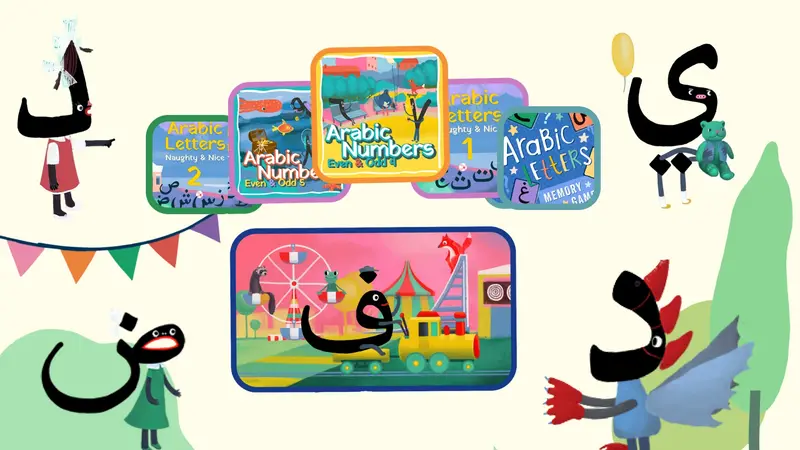
How to Teach the Arabic Alphabet at Home (When You Can't Read It Yourself)
Children don't remember shapes. They remember characters, stories and games. What we learned building the Arabic letters in Miraj, and how to use it at home.

Is YouTube Haram for Kids?
Is YouTube haram? What do scholars say? How app design affects children, and a 7-point framework to judge apps safe for children. Plus: screen-free alternatives for Muslim families.