
Did Musa St-St-Stutter Too?
A boy with a stutter fakes the flu to miss his class speech, until his mother tells him about Prophet Musa (AS), in a picture book for ages 4 to 9.
Start with a 7-day free trial.
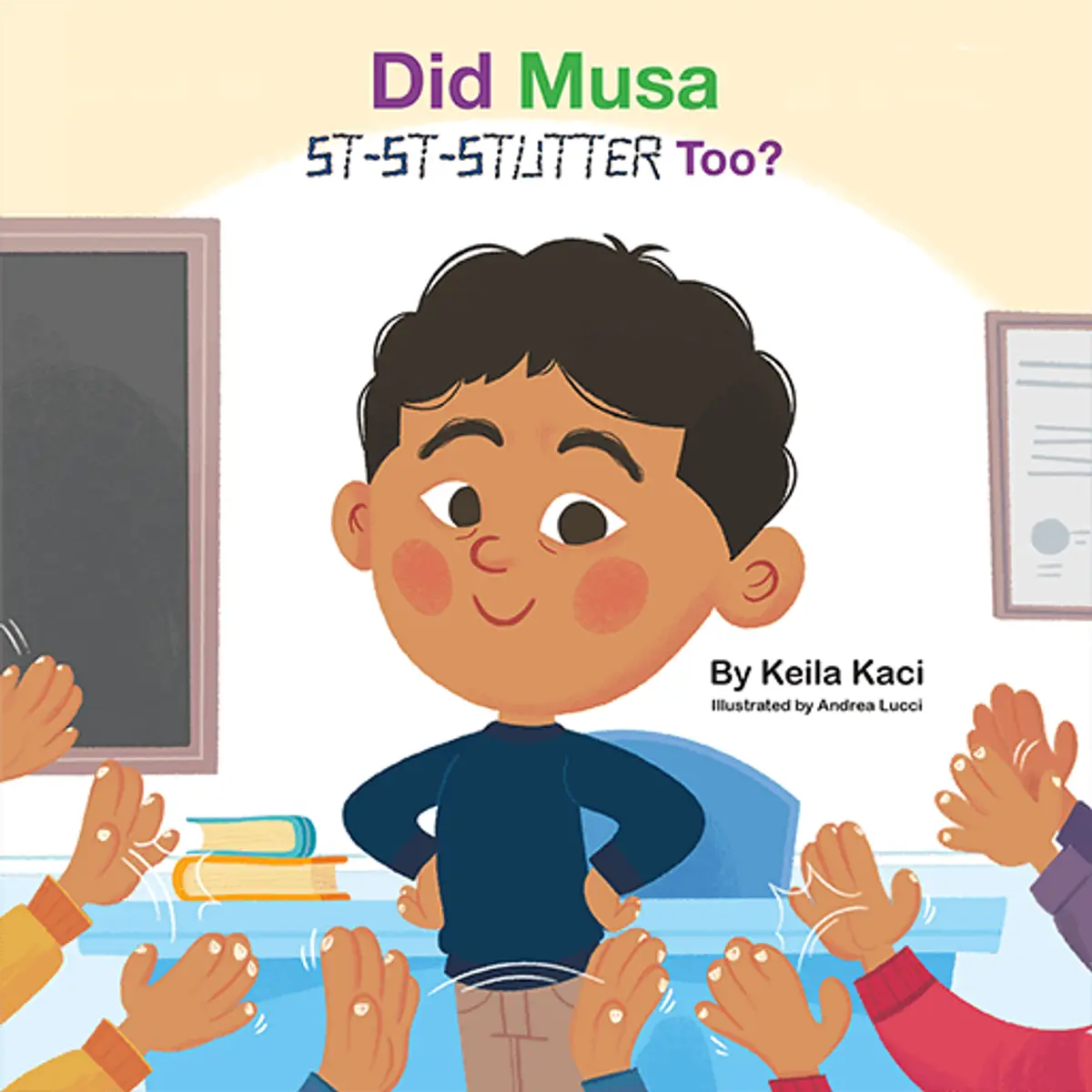
What is Did Musa St-St-Stutter Too? about?
Did Musa St-St-Stutter Too? is an Islamic picture book for children aged 4 to 9 about Ibrahimi, a boy who is afraid to give a speech in class because of his stutter, and the mother who reminds him of the Prophet Musa (AS) and his dua.
Ibrahimi knows his book report well, but he is scared his class will laugh at his stutter. So he fakes a cough, flushes his cheeks and moans that he has the flu. His mother sees through the trick, but she plays along and tucks him into bed. She tells him how much she loves his voice, stuttered, loud or clear. Ibrahimi wishes he had a strong, sure voice, because he thinks no one will take him seriously.
His mother tells him that a stutter is not a curse but a trial, like the one Allah gave Prophet Musa (AS), whose tongue was tied in a knot whenever he spoke. Yet Musa is remembered for his words, not his strength. She teaches Ibrahimi the dua Musa made, asking Allah to put his heart at peace, make his task easy and remove the knot from his tongue.
Told in rhyme, the story shows children that a difficulty is not a failing, that honesty is better than pretending, and that dua can calm their nerves. Ibrahimi goes to school with the dua in his head, and his class claps and cheers. The book is written by Keila Kaci and illustrated by Andrea Lucci.
What your child will learn
- A difficulty like a stutter is a trial from Allah, not a sign that He is displeased.
- Prophet Musa (AS) made dua to Allah for ease in his speech.
- We can say Musa's dua when we are nervous about speaking.
- Being honest is better than pretending to be ill.
- Our family loves us just as we are.
The story of Did Musa St-St-Stutter Too?
Itty-bitty Ibrahimi was a little scared. He had to give a speech in class, and he did not feel ready. He knew his book report well, and he knew the order of everything that happened in it. But Ibrahimi had a stutter, and he was afraid his class would laugh at him, or wince when he spoke.
So he made a plan. He put a warm cloth on his head and faked a cough or two. He made his cheeks flush, and with a moan he announced, "I have the flu." He stumbled along the hallway and down the stairs, tumbling past his sisters and giving them a fright. "Mummy, Mummy," he called, "I'm very, very sick!"
His mother was clever, and she knew straight away that it was a trick. She felt his forehead anyway. Then, instead of scolding him, she gasped and gave him a tender hug, because she thought this might be fun. "Oh, my poor baby," she cried. "Straight back to bed for you. What are the odds that you would get sick on the day of your speech?"
She hurried Ibrahimi up the stairs, tucked him in tightly and kissed his head. "Sorry, I'm staying home," he said. "As you can see, I have no choice."
His mother answered him lovingly. "Oh, how I love this voice. Every word you speak brings me love and joy. Whether it is stuttered, loud or clear, I am proud that you are my boy."
Ibrahimi thanked her, but he told her how much his stutter upset him. A letter here and a sound there made his skin crawl. He wished he had been given a voice that was sure and strong. "No one will take me seriously," he said, "when I sound so very wrong."
His mother told him that his stutter was not a curse. It was a trial, just like the one Allah gave to the beloved Prophet Musa (AS). Musa was strong and wealthy, but whenever he spoke, his tongue was tied in a tight knot. Once, when he stepped in to defend someone, his strength was too much, and with a single punch he hurt another man. Yet people do not remember Musa for his strength. They remember him for the words he spoke, and with those words he brought a whole nation to its knees.
Then his mother taught him a dua to say when he stood up in front of his class, so that his nerves would pass: "My Lord, put my heart at peace and make my task easy for me. Remove the knot from my tongue, so that they may understand my speech."
With those words, Ibrahimi knew what he had to do. He faced his fear and called out, "I do not have the flu!" On his way to school, the dua played over and over in his head. Insha'Allah, he thought, his fear would be replaced by hope and faith.
When it was his turn, the words flowed out easily, with a hiccup here and there. His classmates did not seem to mind at all. They clapped and cheered as he finished his speech. And between the whoops and the cheers, Ibrahimi hoped they had heard what he said at the very end: "I may not speak exactly like you, or you, or you, but I am in good company, because Musa stuttered too."
Find more about Prophet Musa (AS) and more stories about courage, making dua and family.
Where this story comes from
- Surah Ta-Ha 20:25-28: Musa prays, "My Lord, expand my chest for me, ease my task for me, and untie the knot from my tongue, so that they may understand my speech."
- Surah Al-Qasas 28:15: Musa strikes a man once to defend another, and the man dies.
Talk about it afterwards
- Why did Ibrahimi pretend to have the flu?
- What did his mother say she loved about his voice?
- What dua did Prophet Musa (AS) make?
- When could you say Musa's dua?
- How did Ibrahimi's class react to his speech?
Words to know
- Dua
- Asking Allah for something.
- Insha'Allah
- If Allah wills.
Frequently asked questions
What age is Did Musa St-St-Stutter Too? suitable for?
Children aged 4 to 9. It is told in gentle rhyme, and it is a good book for any child who feels nervous about speaking in front of others.
Is Did Musa St-St-Stutter Too? based on the Qur'an?
Yes. The dua Ibrahimi learns is the one Prophet Musa (AS) made in Surah Ta-Ha 20:25-28, asking Allah to untie the knot from his tongue.
Who wrote Did Musa St-St-Stutter Too?
Keila Kaci wrote it and Andrea Lucci illustrated it.
More like this

Juz by Juz: Allah and Musa
Video · Ages 4-9 · 12 min

Juz by Juz: The Believer from Firawn's Family
Video · Ages 7-9 · 13 min

Al Waliy
Video · Ages 7-9 · 5 min
Baba, What Does My Name Mean?
Story · Ages 4-12 · 11 min