
25 Ramadan Activities for Kids at Home, With a Free Calendar
Twenty-five short Ramadan activities for children aged 2 to 9, sorted by age and by part of the month, with a free printable moon calendar that works every year.
13 min read Areeba Hasan
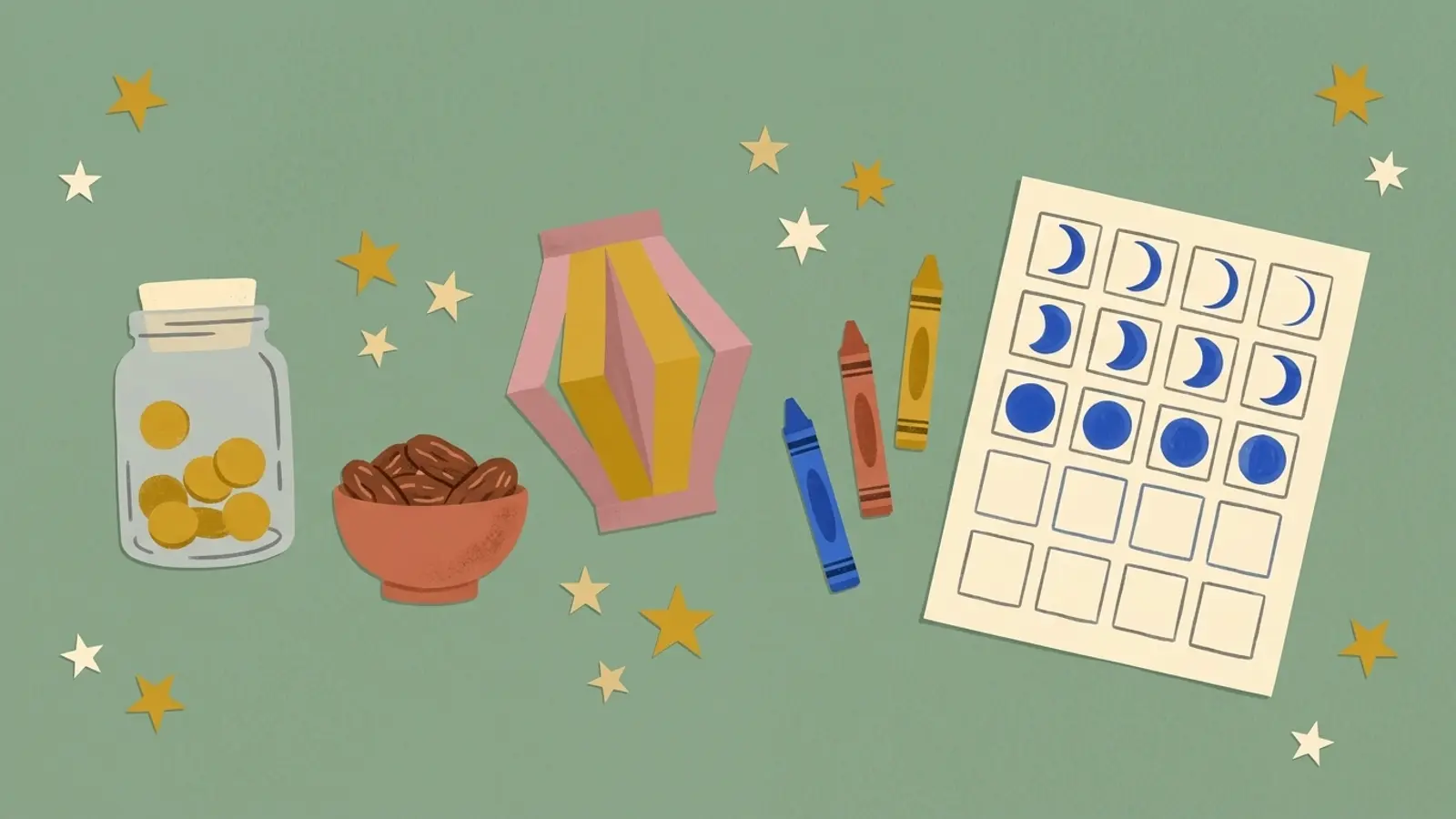
Summary
The best Ramadan activities for young children are short, happen every day and give them a real part in the month: a moon calendar to colour each evening, a job at iftar, a good-deeds jar and a story at bedtime. Below are 25 ideas for ages 2 to 9, sorted by when in the month and tagged by age, with a free printable moon calendar that works every year.
Your four-year-old wants to fast like everyone else, your seven-year-old is asking how many days until Eid, and you have no time for a new craft every evening. You want the month to feel special for them without it becoming one more thing to manage.
Start with one thing on the fridge, a free printable Ramadan moon calendar, add a job at iftar and a story at bedtime, and pick a few extras from the list below. Each of the 25 ideas is tagged by age (2 to 4, 5 to 7, 8 and up) and sorted by when in the month it fits. For stories and games through the month, see our Ramadan stories and games for children.
What is the easiest Ramadan activity to start with?
The easiest Ramadan activity is a moon calendar on the fridge: one box a day, coloured in each evening, with the moon as it looks that night. It takes two minutes, it works for a three year old and a nine year old, and it turns the month into something a child can see.
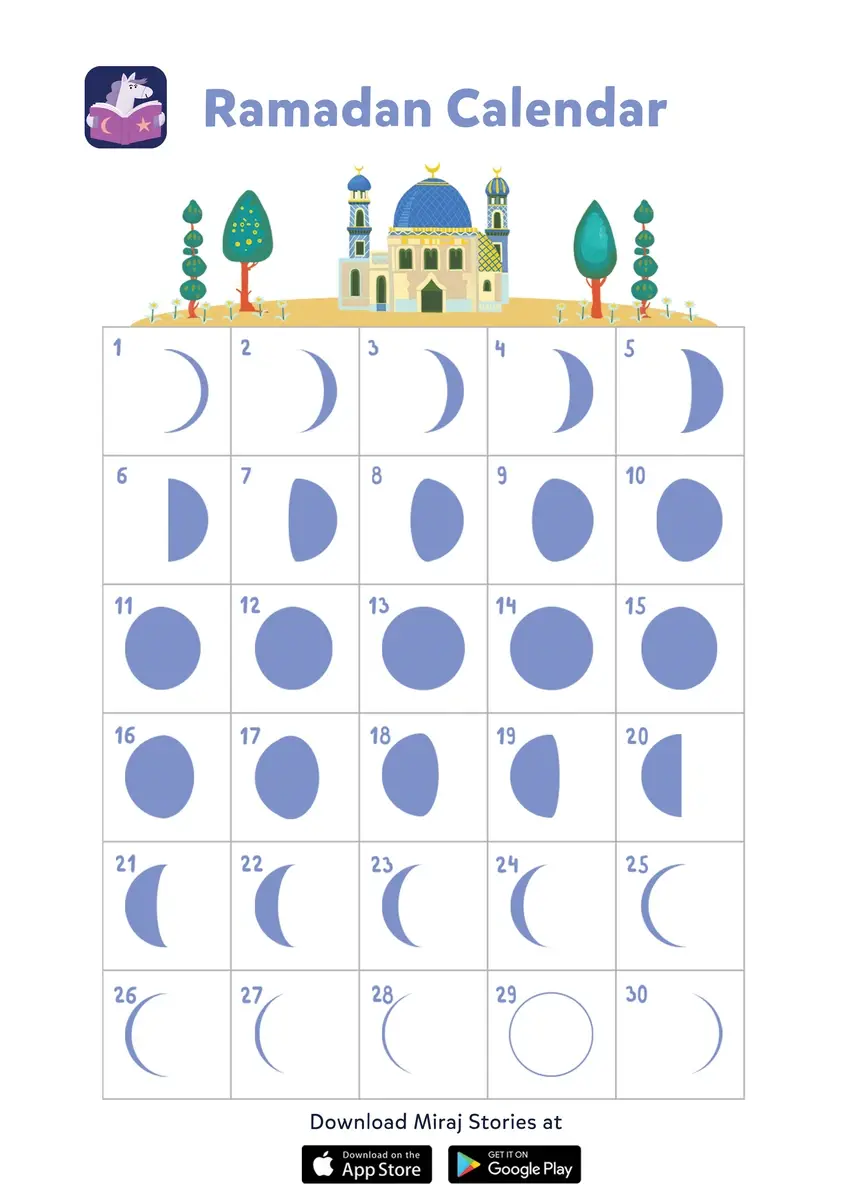
Our printable Ramadan calendar for kids is made for this. It is one A4 page in portrait for children aged 3 to 9, with thirty boxes numbered 1 to 30 and no dates, so it works every year. It is free for personal and classroom use, and we email you the download link.
How to use it:
- Put it up on the first day of Ramadan, at your child's eye level.
- Colour the day's box after iftar, or add a sticker or a tick.
- Step outside and look at the real moon. Does it match the box?
- Count the boxes left until Eid.
- Write one good deed in each box for a child who can write: a kind word, a dua, sharing iftar.
If the month has 29 days, leave the last box empty or colour it in for Eid.
How can children get ready before Ramadan?
Children get ready best with a countdown, one decorated corner and a first look for the new moon. Ramadan 1448 is expected to begin on Monday 8 February 2027 in most countries and Tuesday 9 February in a few (timeanddate), depending on when the crescent is seen, so check the date with your mosque.
1. Count down the weeks (ages 4 and up). From mid-January, cross off a week on the kitchen calendar each Friday. Talk about one thing you will do in Ramadan each time.
2. Decorate one corner (all ages). A string of paper stars, a paper lantern and a basket of Ramadan books are enough. Let the youngest stick the stars on. One corner is easier to keep up than a whole house.
3. Make a good-deeds jar (ages 3 and up). Write small, doable deeds on folded slips: "Help lay the table", "Say a dua for Nani", "Share a toy". Your child pulls one out each morning of Ramadan.

4. Look for the new moon (all ages). On the evening before the expected start, go outside just after sunset and look low in the west for a thin crescent. If you don't see it, that is part of the lesson: some communities begin Ramadan when the crescent is seen locally, others by a sighting elsewhere or by calculation, and your mosque will tell you which day it is.
5. A practice half-day for the older child (ages 8 and up). If your child wants to try fasting, a morning until lunch on a weekend before Ramadan is a gentle start. See what age children start fasting for the range of views and an age-by-age plan.
What can children do every day of Ramadan?
Children need one or two small things they do every day, not a new project each night. Pick from these and keep the same ones all month.
6. Colour the day's moon (ages 3 to 9). The calendar above, after iftar, every night.
7. The iftar job (ages 2 and up). Give your child a real task: put the dates and the water on the table. It is the Sunnah way to open the fast: the Prophet Muhammad (peace be upon him) "used to break his fast before praying with some rutabah dates; but if there were no rutabah dates, he had a few fully ripened dates, and if there were no fully ripened dates, he took some mouthfuls of water" (Sunan Abu Dawud 2356, graded hasan sahih by al-Albani). Rutabah are fresh, soft dates; any dates will do. A two year old can carry the bowl of dates.
8. A good deed a day (ages 3 and up). Use the slip from the jar. Smiling counts: the Prophet (peace be upon him) said "Your smiling in the face of your brother is charity" (Jami' al-Tirmidhi 1956, graded sahih by al-Albani; al-Tirmidhi called it hasan gharib). That one even a toddler can do.
9. A Ramadan story at bedtime (ages 3 to 9). One story about the month each night, with favourites read again. Two on our Ramadan shelf: Esa's Ramadan Countdown, about a boy who tries a practice fast before Ramadan, and Aziza's First Fast, a 13-minute audiobook about a girl who keeps her first fast until Maghrib. Both are in the Miraj Stories app, which plays them without ads, so a tired child can listen with the lights down.
10. Suhoor at the weekend (ages 6 and up). Wake an older child for suhoor once a week, on a Friday or Saturday night. Eating with the family in the dark is the part many children remember most.
11. A Ramadan colouring page (ages 3 to 7). Our Ramadan colouring page shows Kamal the Kangaroo with his iftar of dates, water, an apple and a plate of dinner. It is free to print, with no sign-up, and good for a quiet half hour before iftar when everyone is tired.
12. Pray one salah together (ages 5 and up). Choose one prayer, often Maghrib after iftar, and pray it side by side each day. A salah chart on the wall lets your child tick it off.
What Ramadan activities work in the middle of the month?
The middle of the month is when the novelty wears off, so this is the time for something new that looks outwards: to neighbours, to people in need and to the Quran.
13. A full-moon walk (all ages). In the middle of the month, the moon in the calendar is full. Go for a short walk after iftar and find it. Ask your child: "Is it getting bigger or smaller now?"
14. Iftar for a neighbour (ages 4 and up). Make a plate of dates or a few samosas and take it next door. If your neighbours are fasting, the Prophet (peace be upon him) said: "Whoever provides the food for a fasting person to break his fast with, then for him is the same reward as his" (Jami' al-Tirmidhi 807, hasan sahih). If they are not, it is a gift from a good neighbour all the same. Let your child be the one who carries the plate and knocks on the door.
15. Count the sadaqah jar (ages 4 and up). Keep a jar for coins from the first day, and at mid-month tip it out and count it together. Decide as a family who it will help.
16. Learn one short surah (ages 4 and up). Ramadan is the month of the Quran: "The month of Ramadan [is that] in which was revealed the Quran, a guidance for the people" (Quran 2:185, Sahih International). One short surah over the month, a few words a night, is a good goal for a young child. Al-Ikhlas and Al-Kawthar are a common place to start.
17. A card for someone on their own (ages 5 and up). Draw a crescent, write "Ramadan Mubarak" and post it to a grandparent or an older neighbour who lives alone.
How can children join in the last ten nights?
Children join in the last ten nights by making one night special, learning a short dua and putting a light in the window. These are the nights of Laylat al-Qadr, of which Allah says: "The Night of Decree is better than a thousand months" (Quran 97:3, Sahih International). No one knows which night it is. The Prophet (peace be upon him) said: "Seek Laylat al-Qadr on the odd nights among the last ten nights of Ramadan" (Sahih al-Bukhari 2017).

18. A Laylat al-Qadr night in (ages 5 and up). On one odd night, let your child stay up a little later. Make it feel different: a prayer mat each, a torch, a story, two rakat together, then bed. A small child does not need the whole night.
19. The Laylat al-Qadr dua (ages 4 and up). 'Aishah (may Allah be pleased with her) asked what to say on that night, and the Prophet (peace be upon him) taught her: "allāhumma innaka ʿafuwwun karīmun, tuḥibb al-ʿafwa, faʿfu ʿanni", "O Allah, You are Pardoning and Generous; You love pardon, so pardon me" (Jami' al-Tirmidhi 3513, hasan sahih). Teach a small child the last words, "faʿfu ʿanni" (so pardon me), or the meaning in English: "Allah, You love to forgive, so forgive me."
20. A lantern in the window (ages 3 and up). Make a paper lantern from a jam jar and tissue paper with a battery tea light inside, and switch it on each of the last ten nights.
21. A "thank you, Allah" list (ages 5 and up). Each night, your child adds one thing they are thankful for. The verse about Ramadan ends "and perhaps you will be grateful" (Quran 2:185, Sahih International).
What can children do for Eid al-Fitr?
Children love the run-up to Eid most: giving, getting ready and the first dates of the morning. Eid al-Fitr 2027 is expected on Wednesday 10 March in most countries, including the UK (timeanddate), though timeanddate's UK page notes that "there may be one-day error depending on when the Crescent Moon is first seen".
22. Pay zakat al-fitr together (ages 5 and up). Zakat al-fitr is due "on every Muslim slave or free, male or female, young or old", paid "before the people went out to offer the ʿId prayer" (Sahih al-Bukhari 1503). So it is due for your child too. Let your child hand over the money or press "pay" with you, and explain that it means everyone can eat on Eid. Your mosque will tell you the amount.
23. Eid treats for the neighbours (ages 3 and up). Fill small bags with sweets, add a card that says "Eid Mubarak", and deliver them on Eid morning.
24. Lay out the Eid clothes (ages 2 and up). On the last evening, choose the Eid clothes and put them out together. For a small child, this is the moment Eid becomes real.
25. Dates before the Eid prayer (all ages). The Prophet (peace be upon him) "never proceeded (for the prayer) on the Day of ʿId-ul-Fitr unless he had eaten some dates", and "used to eat odd number of dates" (Sahih al-Bukhari 953). Let your child count out three for each person.
How do I give a child who is too young to fast a real part?
Give them jobs that are worship in their own right, and tell them so. Children do not have to fast before puberty: the Prophet (peace be upon him) named "a boy till he reaches puberty" among those "whose actions are not recorded" (Sunan Abu Dawud 4403, graded sahih by al-Albani). Even so, the Companions brought children in early. Ar-Rubi' bint Mu'awwidh (may Allah be pleased with her) said that on the day of Ashura they would "also make our boys fast", and made them toys of wool: when a child cried, "he was given those toys till it was the time of the breaking of the fast" (Sahih al-Bukhari 1960).
Those children were practising the fast themselves, and the toys helped them last until iftar. A child who is not fasting yet can still have a part in the day: the iftar job, the good-deeds jar, the calendar and the neighbour's plate. Each one is a real deed, and the child can see it matters: the dates they put out are the ones the family breaks the fast with.
How much a child practises fasting, and from what age, is where families and scholars differ. Our post on what age children should start fasting sets out the range of views and a gentle plan. For the words to explain the month itself, see Ramadan explained for kids.
Which Ramadan activities suit a toddler, a five year old and an eight year old?
Toddlers need things to touch and carry, five year olds need a routine, and eight year olds need a real responsibility.
| Age | Start with | Add when ready |
|---|---|---|
| 2 to 4 | The iftar job (7), colouring the moon with you (6), the Eid clothes (24) | Stars for the Ramadan corner (2), a smile as a good deed (8) |
| 5 to 7 | The calendar on their own (6), the good-deeds jar (3), a bedtime story (9) | Iftar for a neighbour (14), the Laylat al-Qadr night (18), the dua (19) |
| 8 and up | Writing a deed in each box (6), counting the sadaqah jar (15), suhoor at the weekend (10) | A practice half-day (5), paying zakat al-fitr with you (22), a short surah (16) |
For a two year old, Ramadan is mostly the sound of the family waking in the dark and the bowl of dates they get to carry. That is enough.
How can teachers use these activities in class?
Teachers can put one moon calendar on the classroom wall and colour a box each morning, then use the colouring page on a wet afternoon. Both printables are free for classroom use, so print as many copies as your class needs. The good-deeds jar works for a whole class too. For the reasons behind the month, Ramadan explained for kids has a section for the classroom.
Frequently asked questions about Ramadan activities for kids
When is Ramadan 2027?
Ramadan 2027 is expected to begin on Monday 8 February 2027 in most countries, or Tuesday 9 February in a few, depending on when the new moon is seen (timeanddate). Eid al-Fitr is expected on Wednesday 10 March. Check the dates with your local mosque.
What are good Ramadan activities for toddlers?
A toddler can carry the dates to the iftar table, colour a moon with you, stick stars on the wall, smile as a good deed and listen to a short story at bedtime. Keep it to one or two things a day, at the same time each day.
How do I make Ramadan special for a child who doesn't fast?
Give them their own jobs and call them worship: the iftar job, a good deed a day, a plate for a neighbour and the moon calendar. Each job is a real deed the family can see: the dates they put out are the ones everyone breaks the fast with. That makes them a real part of the month, not a consolation.
Is there a free printable Ramadan calendar or PDF for kids?
Yes. Our Ramadan moon calendar is a free one-page A4 PDF for ages 3 to 9, numbered 1 to 30 with no dates, so it works every year; we email you the link. The Ramadan colouring page (or coloring page, in the US) is a free PDF too, with no sign-up.
What should I put in a Ramadan calendar?
The day's number, the moon as it looks that night and space for one good deed. A young child colours the box; an older child writes the deed.
Start this year with the free Ramadan moon calendar, and find a story for each night on our Ramadan page for families.
Explore the Miraj library
Explore the whole library
Read more from Miraj for Grown-ups
What Is the 7-7-7 Rule in Islam? Where It Comes From
The 7-7-7 rule splits childhood into play, teaching and keeping close. Where it comes from, whether it is a hadith, and how to use each stage at home.

Islamic Bedtime Stories for Kids to Listen To, by Age
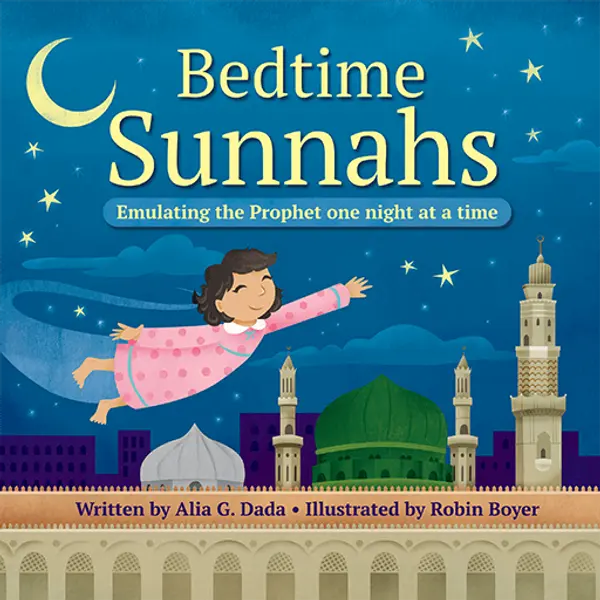
Islamic audio stories for bedtime, picked by age, with the bedtime sunnahs and their hadith, and a way to play them with the screen off.
Ramadan Explained for Kids: What It Is and Why We Fast
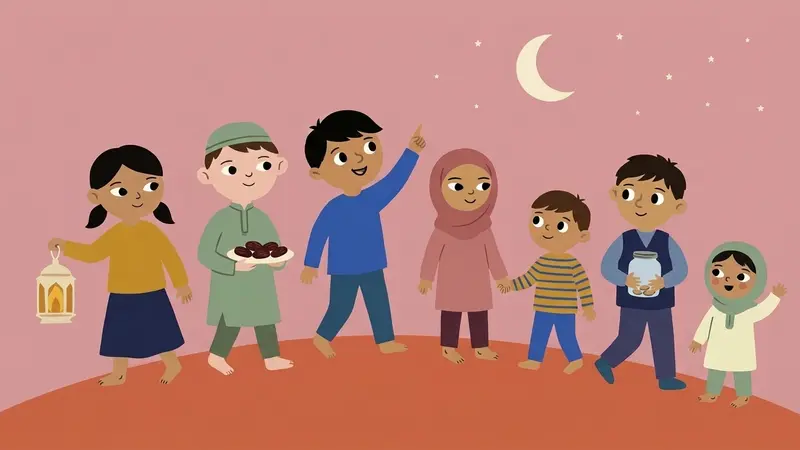
How to explain Ramadan to your child, with words for each age, answers to the questions children ask, and ten facts for school.